


 newsitems CoE Governance Head Mollari to EF:"e"-Democracy Ready to Boost Citizens Participation since Pandemic
CoE Governance Head Mollari to EF:"e"-Democracy Ready to Boost Citizens Participation since Pandemic


*Strasbourg/Angelo Marcopolo/- Replying to a relevant "Eurofora"s Question, the President a.i. of CoE's prestigious PanEuropean Committee on Democracy and Governance, Markku Mollari, from Finland, announced, in substance, that Digital "E"-Democracy is practically Ready, Nowadays, to Help Boost Citizens Participation to Public Decision-Making, (along the main lines of "Eurofora"s Project), particularly since the current Pandemic Virus' Crisis.
- And he did Not Exclude, a priori, that this may, "Later"-on, even "Lead" also to a "Hard Law", throughout CoE's 47 Member Countries, (See Infra).
Significantly, he said that in the Context of a landmark CoE's International Conference on civil Participation in Decision-Making, where "Eurofora" had been Invited to take an active part, by CoE's Presidency by Georgia, (November 2019-May 2020, shortly before Greece takes over, Later this Month, for the Period of May - November 2020, followed by Germany). Initially Scheduled for the Beginning of March in Strasbourg, this was the 1st CoE's International Conference obliged to be Postponed sine die, because of the Deadly Virus' Crisis, But it Resumed Nowadays, precisely in the Form of a Digital Web-Conference...
-------------------------
- "Eurofora" had practically Asked President Markku Mollari :
(A) "WHEN" he expected that a Link between "e-Democracy" and "civil Participation" might be Developed by the CoE, as he had Highlighted Earlier (See Infra), and Whether he "could ... be ... Explicit about its Content".
(B) "IF" he thought that, even an eventually "Soft Law" (f.ex. in the Form of a CoE's "Recommendation"), might, eventually, Become, Later-on, "at least Partially, also "Hard Law", f.ex. via National Judges' Case-Law, Legislators, Administrative Practice, etc., perhaps Coordinated by ECHR".
-------------------------------------------
- (A) "Thank you. To Answer the 1st Part of Your Question, the Guidelines on E-Democracy ...have Already been approved by the (CoE's) Committee on Democracy and Governance...", its President sharply replied to "Eurofora".
- But, at least for the Time being, this has been done "in the Form of a Toolkit", and just "in Substance", Not Yet "in their Final Version", as he pointed out.
=> In Consequence, "they Will be (Definitively and Completely) Approved", once Finalized, "in the (CoE) Committee's Next Plenary meeting", which is due, "most Likely", to be organized around this "Summer" 2020, (i.e. during the InComing Greek CoE's Presidency of May-November 2020), he Carefully Announced.
+ In Fact, these New (2020) CoE's "Guidelines" have a Solid "Base" "on Recommendation CM/Rec(2009)1 of the Committee of Ministers (CoE's Highest Political Body) to member States, on Electronic (e)-Democracy", Markku Mollari reminded. Which is "the 1st International Legal Instrument to set Standards in the field of E-Democracy" in the World, already 15 Years Earlier...
+ Concerning their Content (Comp. Supra), "in Line with the Focus on Multi-Level governance of the (CoE's) Committee on Democracy and Governance" in general, these New (2020) "Guidelines seek to provide Authorities at All Levels, with concrete Examples of Policies, Measures and Mechanisms that can contribute to EnRiching a Democratic Culture and Strengthening Democratic Practices and institutions, at National, Regional and Local level", he added.
++ Moreover, "these (New, 2020 CoE's) Guidelines are addressed to the Broad Range of Stakeholders, such as Public Authorities and their representatives, Political" organisations, "Individuals (Citizens), NGOs, and Civil Society at large, including Media, and the Business community", he specified. This is "In Line with the Consistent Approach Used by the CoE in the area of Democracy" in general.
+++ The, ("Currently Finalized"), "Documents include (also) Mechanisms related to e-Participation, e-Petitions and e-Referendums", he revealed Earlier, (but withOut going into Concrete Details).
----------------------------
(B) "With regards to Your 2nd Question, (Comp. Supra), these "Soft" Tools are meant to be Practical, and Helpful – they should be relatively Easy to apply... We intended for the many Examples in the document from various countries to act as an Inspiration - to apply them as Appropriate, share Ideas and get new ones", President Mollari Replied to "Eurofora".
- This goes "Even in Difficult circumstances", he Stressed.
+ However, At the Moment, he felt that "it is Too Early (sic !) to say Whether these will Lead to any “Hard Law”", (But withOut Excluding Anything, a priori)...
=> "That should be Evaluated Later", he Wisely Concluded, Replying to Our Ultime Query (Comp. Supra), in a way which Left the Future Open !
Topicaly,, CoE's Democracy/Governance Committee's President Markku Mollari from Finland, said that to "Eurofora", Just 1 Month Before the next EU Heads of State/Government Summit, on Mid-June, which is due to Deal also with the Forthcoming Exceptional "Conference on Europe's Future" (2020-2021+), where EU Citizens' Participation to Public Decision-Making is Notoriously at the Focus...
- At any case, it's a Fact that, "in the Present Day – no less during our current Health Emergency –", "one canNot discuss civil Participation withOut referring to anOther Theme, closely followed by the European (EU+CoE) community: e-Democracy", righfully Mollari Stressed Earlier.
- Because "Digital tools and Technologies can, and should, Support Democratic processes, by providing increased Access to political Decision-making, and enabling Citizens to Participate in the public Debate, in New Ways" he underlined.
=> That's why, "the good cooperation between New Tools (Internet) and Traditional tools of Participation, is the Key to building better Trust ...between different levels of Government and the wider civil Society", "Reflecting the Centrality of this topic for the present and future of Democratic practice".
At a Moment when the In-coming CoE's Greek Presidency, later this Month, (May-November 2020) seems reportedly due to Focus, precisely, on such Digital Tools, Both in order to ByPass Problems raised by the Virus' Crisis, and in order to Boost a Public Democratic Debate with Citizens on core Human Rights, Democracy and Rule of Law during Pandemics, while, at the Same Time, also the EU Leaders prepare an Exceptional 2020-2021 Conference on "Europe's Future", due to Focus also on EU Citizens' Participation to the Decision-making, the above-mentioned Key Observations of PanEuropean CoE's "Democracy and Governance" Committee's experienced President, are certainly of key Topical Interest.
(../..)
("Draft-News")
-----------------------------------------
Main Menu
Αρχική Press Deontology/Ethics 2009 Innovation Year EU endorses EuroFora's idea Multi-Lingual FORUM Subscribers/Donors Συχνές ερωτήσεις Η άδεια του Elxis Σύνθετη αναζήτηση EuroFora supports Seabird newsitems In Brief European Headquarters' MAPs CoE Journalists Protection Platform
BRIEF NEWS
- 00:00 - 02.06.2021
- 00:00 - 18.10.2020
- 00:00 - 19.06.2020
- 00:00 - 18.05.2020
- 00:00 - 20.04.2020
- 00:00 - 02.02.2020
- 00:00 - 09.12.2019
- 00:00 - 27.11.2019
- 00:00 - 16.11.2019
Popular
- Yes, we could have prevented Ferguson riots says World Democracy Forum's Young American NGO to ERFRA
- Spanish People Elect CenterRIGHT Majority with 1st Party and Total of 178 MPs (6 More than the Left)
- Pflimlin's vision
- The European Athletic "Dream Team", after Barcelona 2010 Sport Championship Results
- Source Conseil d'Europe à ERFRA: Debatre Liberté d'Opposants à Loi livrant Mariage+Enfants à Homos ?
- Head of BioEthics InterGroup, MEP Peter Liese : "Embryonic stem cell research reaching its END" !?
- Spain: Jailed Turkish Terror suspect with Explosive,Drones,Chechen accomplices stirs Merah+ Burgas ?
- UN Head Ban Ki Moon at CoE World Democracy Forum : - "Listen to the People !"
Latest News
- Test Photos (f.ex.+ Invit to EU + Korea Peace meeting)
- EUOmbudsmen Conference 2022: Digital Gaps affect People's Trust threaten EF Project on EU Future ?
- French Election : Black Out on Virus, but Obligation for Fake 'Vaccines" Challenged
- Both French Presidential Candidates point at "Humanism" in crucial times...
- France : Zemmour = Outsider may become Game Changer in Presidential + Parliamentary Elections 2022
Statistics
Επισκέπτες: 63024660Archive
Login Form
Syndicate


Other Menu
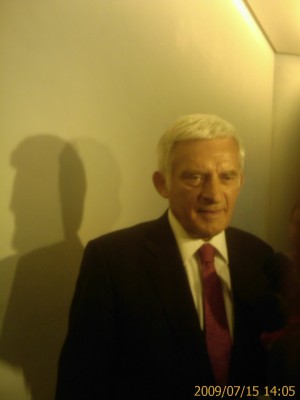
Speaking exclusively to "EuroFora", the New EU Parliament's President, former Polish Prime Minister, ChristianDemocrat/EPP MEP Jerzy Busek, welcomed proposals by EuroFora about innovative ways for EU Citizens to attend EU debates before important final decisions which affect people's lives.
- "We (EU Parliament) must be transparent", Buzek stressed from the outset. "We must have clear answers also for delicate questions. If we don't touch a problem, you must know why, and when shall we decide in the nearest future".. "Because "we (EU) must think about Europeans, first of all : They don't understand well what is going on in the EU. So, it's our duty to inform them, to make discussions here more interesting".
"EuroFora" congratulated President Buzek for the anouncement he made, from the 1st day of his election in Strasbourg (on Tuesday, 14 July 2009), on his intention to make transparent debates, exchanges of views, etc. before the final adoption of decisions in EU Parliament's Plenary, when issues are evolving inside Committees, (See earlier publication).
And we reminded, in this regard, that "EuroFora" has been advocating a project for EU Citizens' active involvement in pluralist EU debates before important EU decisions, since more than a Decade : 1997-2007+
- "Thank you. We (EU Parliament), indeed, have exciting debates", Buzek replied. But, in practice, "without a possibility for our Citizens to see them, not even by the Press, the Radio or TV, etc., because it is in Committees", he regreted.
- "But, they (i.e. Media, Citizens, etc) might interact with you, with MEPs, etc, May be we can imagine something", "EuroFora" proposed.
- "Yes, (but) it needs, a quite new idea", Buzed observed.
- "Why not through some innovations ?", "EuroFora" suggested.
- "Precisely, "EuroFora" has such a project, since more than a Decade (1997-2009), to use new technologies for public debates before major EU decisions are taken", we reminded.
- "If you have such proposals, please come to us, come to us. We must" do something, agreed the new EU Parliamen's President.
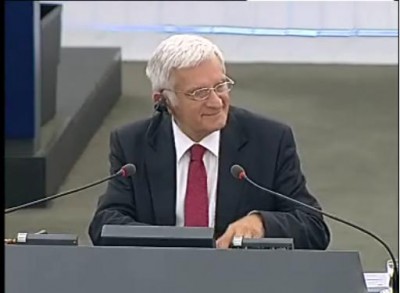
For that purpose, obviously information and debates are valuable, but purely instrumental, procedural means which can help focus on, and highlight a substantial content, attractive to EU Citizens, which needs to be determined by other, political, and not mediatic factors.
Buzek spoke about the urgent need to overcome the Global Economic Crisis, the struggle for Human and Civic Rights, Democracy, etc., the Eastern Partnership, links with Russia, strategic partnership with USA and emerging countries, etc.
But he also used (while speaking both to "EuroFora" and other Media) the expression : "The Europeans", for EU Citizens. This points right towards what several important EU leaders (including French President Sarkozy, German Chancellor Merkel, etc) have started to highlight particularly during the recent years : That there is a vital need, and an historic opportunity, for the development of a European Conscience, to stimulate e renaissance of a European Identity able to attract Popular support, for the EU to become a strong player in a Multopolar World : In other words, the revitalisation of a project for a "Political Europe".
By a coincidence, this was indirectly but surely reminded, earlier in Strasbourg, by another ... Busek (this time with a "s") :
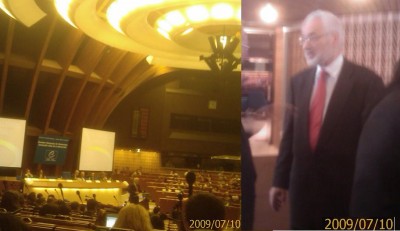
Speaking to more than 650 participants from CoE's member countries, at the conclusion of the 2009 Summer University of its Political Schools, Erhard Busek, (with an "s"), former vice-Chancellor of Austria and EU Coordinator for South-Eastern Europe, pointed at the current need to revitalize Europe's "Identity", forged by Greek philosophy and Roman Law, Christian values and Enlightment's ideas, etc. through the ages.
- "We have almost the same name with Jerzy Buzek (EU Parliament's new President, who is a former Polish Prime Minister), because both our Families come ...from the same village, located at the Heart of Europe, which was often shared between Poland, Germany and the Czech Republic. But my family emmigrated a long time ago to Austria, while Jerzy Buzek's family remained in Poland", explained f. vice-Chancellor Erhard Busek to "EuroFora".
An astonishingly concrete and simple example of European Integration from the grassroots : Starting by EU Citizens, i.e. those "Europeans", that EU Parliament's new President, Jerzy Buzek (this time with a "z"), wants to bring alongside MEP's decision-making proces, (according to "EuroFora"'s main idea : Comp. supra)...