


 newsitems 70% Abstention threat in 2009 brings EU to EuroFora's idea for Citizens debates on big EU decisions
70% Abstention threat in 2009 brings EU to EuroFora's idea for Citizens debates on big EU decisions


Facing a 70% Abstention threat in 2009 Election, EU endorses EuroFora's idea for Citizens' debates on crucial EU decisions !
- Different views on "Europe's Future", should be debated among Citizens at June 2009 EU Elections, thanks to political Parties' "Manifestos", says EU Parliament's Report
A main idea, initiated and promoted by EuroFora's founders since 1997: the vital need to develop European Citizens' democratic right to actively participate in multilingual debates on EU decisions, is formally endorsed by the EU from 2009 !
The move is a key attempt to overcome "catastrophic" Polls which warn that only ...30% of Citizens are ready to vote in the forthcoming June 2009 EU Election ! This was revealed by EU Commission's vice-president, in charge of Communication policy, Margot Wallstrom, during a "hot" meeting of EU Parliament's Committee on Culture and Education, during the December 2008 Strasbourg session.
Wallstrom faced criticism, but also suggestions from various MEPs, naturally worried by Abstention threats which herself found even "worse" than in 1999 or 2004...
A Report on "Active Dialogue with Citizens",examined at the same time, presented some useful practical tips, on "facilitating Interviews"; etc., but also a potentialy important call to "incorporate the conclusions of ...debates...into (EU) policies, and take into consideration the expectations that Citizens have of the EU when deciding". An amendment even implies that Citizens' participation in debates on EU decisions is a democratic "Right".
More importantly, it finds that a Debate "on the Future of Europe", (as French President Nicolas Sarkozy has asked since 2007), would be a good idea " for the 2009 European parliamentary Elections", because "clarifying the political differences between the EU political parties would help citizens to identify themselves with, and choose between various concepts", for which "all parties (should) present their Manifesto".
A "Joint political declaration on Communicating Europe in Partnership", co-signed by "the European Parliament, Council and ... Commission", confirms that they "attach the utmost importance to improving communication on EU issues", by "enabling European citizens to exercise their right to participate in the democratic life of the Union, in which decisions are taken as openly as possible and as closely as possible to the citizens, observing the principles of pluralism, participation, openness and transparency".
This should "enable Citizens to exercise their right to express their views and to participate actively in the public Debate on European Union issues", while also "promoting the respect of multilingualism". In this regard, EU confirms its "wish to develop synergies with national, regional and local authorities as well as with representatives of Civil Society".
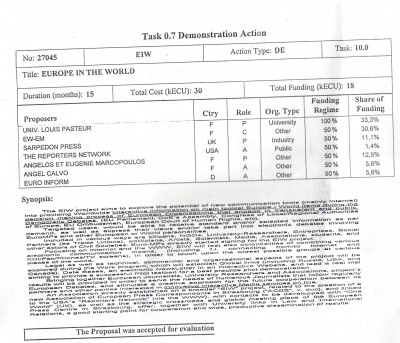
It's since 1997 that a group of EuroFora's founders have officially presented a pioneer Project (then called "EIW", for "Europe in the World"), which aimed to develop Strasbourg's "Polyphonic music", by providing "Interactive information", on "main issues ... during the Decision-making process of European Organizations which engage in Transparent and Public Democratic Debates"
This should be done, inter alia, by "exploring the potential of New Communication Tools (mainly Internet)", as well as classic-form debates, the 1997 EIW pioneer project's anounced in its "Synopsis". It was formally "accepted for evaluation" by EU Commission in Brussels in order to be examined for a grant in the framework of the "Research/Technology/Development (RTD) Programme in the field of Information Technologies", then called "ESPRIT", as a "Best Practice Pilot Project".
But the vital, urgent Political need for EU to search new, efficient ways to reach the People and interact with European Citizens, was really felt in Brussels and elsewhere only after the unprecedented in History 1999 and 2004 Majority Abstention in EU Elections, followed by 3 "NO" in Referenda in France, the Netherlands and Ireland, on 2005 and 2008...
In this New Political Landscape, we prepared a new, actualised and more developed version of our initial idea, in a simplified and more efficient form, thanks also to a large Experience accumulated during many years of EU/CoE/UNO Press work and Multi-lingual debates, with the New project "EuroFora" :
On 2006 we presented in Public its main lines during Questions/Replies that we raised at two Press Conferences by EU Commission President, Jose Baroso, and mainly EU Commission's vice-President, in charge of Communication policy, Margot Wallstrom, together with EU Parliament's vice-president, Alejo Vidal-Quadras, in Strasbourg, (Videos available), and we reminded it at various brief contacts with Commissioner Wallstrom in 2007 and 2008.
Meanwhile, a new Text was also presented for "EuroFora" Project mainly to certain Political and other personalities, at European, National or Regional/Local level, mainly in 2007, but also in 2008..
Now, after the unexpected 2008 Irish "NO", and before the 2009 EU Elections, which are due to be of exceptionally crucial importance for Europe's Future, the moment has obviously come to launch that project, progressively, but in real practice.
Whoever really cares for Europe and its Citizens is welcome to join, in one way or another. Only anti-European, anti-democratic, obscure or ignorant groups might oppose or attempt to "steal" and deviate the main idea.
But European Citizens, incited by enlightened political leaders, are those who will finally write the real History.
Main Menu
Home Press Deontology/Ethics 2009 Innovation Year EU endorses EuroFora's idea Multi-Lingual FORUM Subscribers/Donors FAQs Advanced search EuroFora supports Seabird newsitems In Brief European Headquarters' MAPs CoE Journalists Protection Platform
BRIEF NEWS
- 00:00 - 02.06.2021
- 00:00 - 18.10.2020
- 00:00 - 19.06.2020
- 00:00 - 18.05.2020
- 00:00 - 20.04.2020
- 00:00 - 02.02.2020
- 00:00 - 09.12.2019
- 00:00 - 27.11.2019
- 00:00 - 16.11.2019
Popular
- Yes, we could have prevented Ferguson riots says World Democracy Forum's Young American NGO to ERFRA
- Spanish People Elect CenterRIGHT Majority with 1st Party and Total of 178 MPs (6 More than the Left)
- Pflimlin's vision
- The European Athletic "Dream Team", after Barcelona 2010 Sport Championship Results
- Source Conseil d'Europe à ERFRA: Debatre Liberté d'Opposants à Loi livrant Mariage+Enfants à Homos ?
- Head of BioEthics InterGroup, MEP Peter Liese : "Embryonic stem cell research reaching its END" !?
- Spain: Jailed Turkish Terror suspect with Explosive,Drones,Chechen accomplices stirs Merah+ Burgas ?
- UN Head Ban Ki Moon at CoE World Democracy Forum : - "Listen to the People !"
Latest News
- Test Photos (f.ex.+ Invit to EU + Korea Peace meeting)
- EUOmbudsmen Conference 2022: Digital Gaps affect People's Trust threaten EF Project on EU Future ?
- French Election : Black Out on Virus, but Obligation for Fake 'Vaccines" Challenged
- Both French Presidential Candidates point at "Humanism" in crucial times...
- France : Zemmour = Outsider may become Game Changer in Presidential + Parliamentary Elections 2022
Statistics
Visitors: 67813541Archive
Login Form
Syndicate


Other Menu
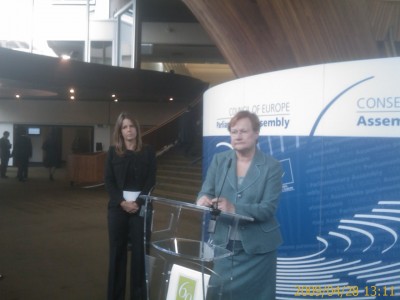
People in Europe and the World expect from CoE to make a succes of its "Monitoring" for Human Rights and Democracy, despite difficulties, said Finland's President Tarja Halonen to "EuroFora" at a crucial moment for the mecanism built 15 years ago by the paneuropean organization which celebrates its 60th Anniversary in 2009.
Halonen, known as "Mother" of CoE's "Monitoring" mecanism, a long-time MEP and former Foreign Minister before becoming Finland's President, holds a long experience in the mattter, after also serving twice as CoE and EU Chairwoman in the past. That's why she is well placed to judge how CoE's "monitoring" should deal today with some crucial issues of importance both to CoE and to the EU.
The move came just a Month before a crucial, last visit to Turkey, scheduled for June, by the President of CoE''s "Monitoring" Committee, Ukranian MEP Serge Holovaty, to finalize his Report on Ankara, the CoE Member State with the longest Monitoring procedure. From its results depends its overall credibility.
This is a Test-case, because, in fact, it's in order to avoid Sanctions threatened against Turkey by a CoE's Assembly's April 1995 Resolution for grave Human Rights violations, Democracy gaps, the continuing Military Occupation in Cyprus, the unresolved Kurdish problem, Aegean differend with Greece, etc., that MEPs decided to create, for the 1st time on April 1996, a "Monitoring" proces, allegedly destinated to check, without excluding Countries who did not fulfill all CoE's standards.
In the Past, the obliged withdrawal of Greece's Military regime and of its "Civil" cover-up out of the CoE had helped bring back Democracy in 1974. But, on the contrary, since April 1996, the idea was to "monitor" Human Rights' respect while keeping most concerned Countries inside the CoE. After Turkey's oldest example, this was extended also to several former "Eastern" European Countries, even if CoE's Assembly has imposed to some of them (fex. Ukraine, Russia, etc., after Belarus, Serbia, etc) various "Sanctions", that Ankara always avoided. Curiously more succesful even than .. USA itself, (a CoE "Observer" since 1995), which has been at least threatened with sanctions some years ago..
EU-effects of CoE's Monitoring process became obvious between 2001-2008, since the "closure" of this procedure, when CoE felt that a Country had met most of its Human Rights, Democracy and Rule of Law obligations, (i.e. the "Copenhagen Criteria" for the EU), helped trigger Negotiations with the EU for "Accession" or other closer relations : This occured already before the 2004 and 2007 EU Enlargements to former "Eastern" European Countries, as well as for the commencement of "accession" negotiations with Croatia, and of "open-ended" negotiations with Turkey in 2005.
But a stricking new development are Holovaty's recent findings that on core Human Rights issues as Torture and Freedom of Expression, Turkey, even "5 Years after" CoE closed its "Monitoring", back in 2004, inciting EU to start accession Negotiations in 2005, still presents grave problems.
His findings are of crucial importance after a 2008 CoE Resolution called, "if need be", to "seriously consider the possibility of Re-Opening the Monitoring procedure for Turkey" : A move which might affect Ankara's controversial EU bid, since EU Accession Negotiations are based on the Hypothesis that the Candidate fullfils the "Copenhagen Criteria" (See above)..
-------------------------
Holovaty expressed his will to check "Matters still Outstanding" and those that he "didn't have an opportunity to discuss" at an earlier visit this year, "in order to discuss the more complex issues in greater depth", at his forthcoming New Visit to Ankara, before the December 2009 EU Summit. This is all based on the 2004 CoE Resolution which stresses that, CoE "will continue.. post-monitoring Dialogue with the Turkish authorities,...in addition to a 12-points list,..and on any Other Matter that might arise in connection with Turkey’s Obligations as a CoE member state".
CoE's Resolution also asks from Turkey "to secure the proper Implementation of Judgements, particularly in the Cyprus v. Turkey InterState case", of 2001, which concerns also the plight of many Hundreds of MISSING People. It adds Turkey's obligations to "execute" ECHR's Judgements in the Loizidou case,..and in particular adopt General Measures to avoid repetition or continuation of Violations found by the Court" to the detriment of Refugees.
Nevertheless, Holovaty said to "EuroFora" that "MISSING" persons,"might be included" and cannot be excluded, but he has yet to examine the situation "to find out which issues will be raised" to the Turkish Government.
Therefore, "EuroFora" asked Halonen, as the Historic "Mother" of CoE's Monitoring mecanism, if she thought that, "whenever there are grave Human Rights Violations, as fex. "MISSING" persons, attested even by ECHR's judgements, they should be always checked by a Monitoring process. Or could they be forgotten ?"
- "We (CoE) must be, at the same time, Fair, Realistic, but not in the mind that "now we have Forgotten", etc., replied to "EuroFora"'s question Halonen, speaking as a matter of general principle.
- "When we think of those People that are suffering from the lack of Democracy, of Human Rights, and of the Rule of Law", "we should find a base on how to deal with the (Monitoring) system more rapidly"', she stressed.
- "Sometimes it's very difficult to combine Transparency and Effectivenes together, particularly in this specific case", she went on to say. But, "I have not found a (CoE Member) Country who could be insensitive in this sens", Halonen answered concerning grave Human Rights violations attested by the ECHR.
- "I have no ready-made answer. I have the expectations that you, in the CoE, will, step by step, find the different types of the monitoring systems."
Also "because this is a part of the UN's Post-Conflict system, (fex. when it comes to Cyprus' MISSING persons), and it's a more Global system". So that, "If we make a succes in Europe, the others will follow", throughout the World. "But they expect that we (Europe) are this opportunity, this Opportunity to make a Succes", Halonen concluded.
In addition, she advised to extend CoE's Monitoring to all its 47 Member States, "because, as long as we hear that, all these monitoring systems are "OK for the neighbor, but not for me", "it's very difficult" to understand. Something which could make easier to Compare...
Finnish MEP Jaako Laakso, former CoE Rapporteur on the Occupied Territories of Cyprus and one of the 5 Signatories of the Historic CoE's call to create the "MONITORING" mecanism since 1996, was more specific : - "We (CoE Assembly) have to find a way for the issue of Cyprus' MISSING People to be better followed", he stressed, anouncing his intention to "speak to Mr. Holovaty" about that. "There might be also other ways", added Laakso.
- The 2008 "Year had been a very Bad one for Turkey with regard to Human Rights in general, and Freedom of Expression in particular", denounced, meanwhile, Holovaty's preliminary Post-Monitoringh Draft Report by Holovaty, published by the CoE on April 2009.
"Amnesty International believes that freedom of expression is not guaranteed given the various articles of the Criminal Code that restrict it. .. "For example, 1,300 Websites are said to have been closed down by the (Turkish) authorities in 2008" ! While "the new Turkish Criminal Code was used to bring a total of 1,072 proceedings between June 2005 and April 2008, and led to the conviction of 192 people", for expressing views. "Representatives of the Özgür Gündem newspaper, which specialises in Kurdish affairs, ..complained about Numerous Attacks on their Freedom of Expression ...as was everyone who advocated a settlement to the question by means other than the intervention of the army" "According to their figures, 19 Newspapers had been suspended 43 times between 4 August 2006 and 4 November 2008" !...
Moreover, on 2008, CoE's "Ministers adopted its 4rth Resolution on the execution of the judgments of the ECHR, ...and outstanding issues regarding 175 Judgements and decisions relating to Turkey delivered between 1996 and 2008... concerning Deaths resulting from the excessive use of force by members of the Security forces, the failure to protect the right to life, the DIisappearance and/or death of individuals, Ill-Treatment and the Destruction of property". CoE's " Ministers urged the Turkish authorities ...to ensure that members of Security forces of all ranks can be prosecuted without administrative
authorisation" for "serious crimes". Holovaty reminded.
"Nonetheless", Holovaty heard anew of "Several cases of Violence committed last year (2008) by the (Turkish) security forces". Amnesty International speaks of Many Cases of ill-treatment and Torture in the prisons and by the police". "Including, fex."'the death of Engin Ceber, a young man of 29 who died on October 2008 as a result of the TORTURE allegedly inflicted on him by police officers, prison staff and members of the gendarmerie. He was part of a group of people arrested on September 2008 during a demonstration and Press Conference in Istanbul'. Proceedings against suspects are "on-going" in this case.
- " I therefore noted an Obvious Contradiction between the Government’s stated “zero tolerance” policy.... of Torture and other forms of ill-treatment, and the different testimonies given", denounced CoE's Rapporteur. Turkish "authorities must make considerable efforts to guarantee that proper investigations are carried out into allegations of abuses by members of the security forces and that perpetrators are effectively punished" "In this respect, I have requested detailed Statistics on the number of Investigations, acquittals and convictions in cases involving allegations of abuse in order to show the positive impact of the measures taken to date", Holovaty said, repeating a permanently unsatisfied CoE's demand to Turkey since a Decade...
- "The Political Crisis that shook the country in the spring of 2008 highlighted the Weaknesses of the (Turkish) Constitution", which comes from the Military regime of 1982, "and the Urgent Need of Reforms", stressed from the outset CoE's Rapporteur in 2009. In particular, "the ...Democratic functioning of state institutions, including the independence of the judicial system, are crucial", he observes.
But, "the Electoral system and the ways in which it is circumvented do not appear to give those elected complete Legitimacy, and tend to pervert the course of direct universal suffrage", denounces Holovaty, observing that, even 5 Years later, Turkey did not yet change the 10% nationwide Threshold for a party to take any seat, which is "far higher" than the "3%" maximum in Europe and already condemned as contrary to European Standards by the CoE.
+ Moreover, EU Parliament's 2009 Report on Turkey, drafted by Dutch MEP Ria Oomen-Ruijten and adopted in Strasbourg on March, expresses "Concern over the Failure of the (Turkish) Judiciary to prosecute cases of Torture and Ill-treatment, the Number of which is Growing". EU also "is concerned about continuing Hostility and Violence against Minorities" in Turkey. It also "calls on the Turkish Government to launch, as a matter of Priority, a Political Initiatve favouring a lasting Settlement of the Kurdish issue, (while "condemning violence.. and terrorist groups"). EU "regrets that No progress has been made on establishing full, systematic Civilian suprevisory functions over the (Turkish) Military".
The final results of Holovaty's 2nd and last visit to Turkley will be known later this year, and, at any case, before EU's December 2009 Summit.