


 newsitems EU Parliament biggest Groups' Leaders to EuroFora on Economy + Political Union after Merkel's call
EU Parliament biggest Groups' Leaders to EuroFora on Economy + Political Union after Merkel's call


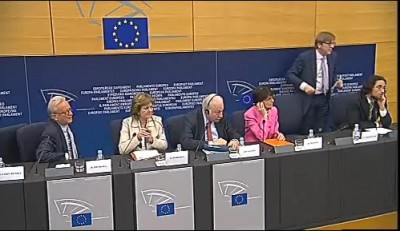
*Strasbourg/EU Parliament/Angelo Marcopolo/- For EU Parliament's biggest Political Groups' Chiefs, Joseph Daul President of ChristianDemocrats/EPP, and Johanes Swoboda, President of Socialist MEPs, speaking to "EuroFora", as well as others, the question of Timing for eventual moves towards an EU Political Union, has apparently become at least as important, as the question of its Principle and/or concrete Content, if not even more Important, in practice, as the current needs to efficiently tackle Economic and Financial issues, as well as German Chancelor Angie Merkel's calls to build a strong and sound EU Political Unification, clearly revealed this week, in the run up to a crucial EU Summit at the End of June in Brussels.
"EuroFora" asked, at a Press Conference of the Leaders of the 4 biggest EU Parliament's political Groups on how to "mutualise" EU Member States' Debts, (See Infra), if and how such proposals articulate with 25 EU Heads of State/Governments' recent sinature of New "EuroArea" Treaty (See "EuroFora"s NewsReports of March 2012, and of December 2011 + January 2012 from EU Summits in Brussels), and/or with German Chancelor Merkel's call for an EU Political Union as indispensable for more Financial Solidarity :
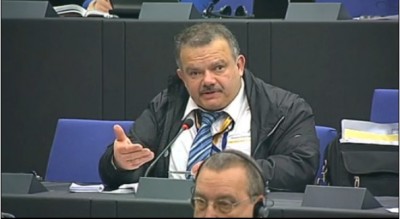
- Speaking from the point of view of "Simple People, Laymen, who have heard many (EU) Projects, (during the recent years), in order to be able to make the Difference, and the Perspectives at the (EU) Horizon", "EuroFora" observed that they had "evoked the "Golden Rule", in fact, another kind of "Gloden Rule" (from that enshrined in the New "€uroArea" Treaty signed on March 2012), more practical, and (had) evoked also the Solidarity and Political Union proposals, which, .. are (still) are on the (EU Negotiations') Table".
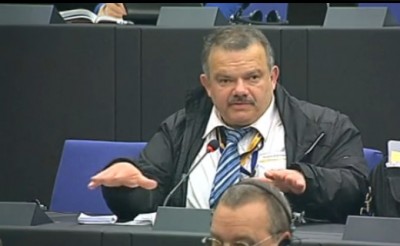
- Therefore, we asked, "as far as it concerns the €uroArea Treaty, that was signed in Brussels (on 3/2012), do you think that, what you do (propose in order to mutualize EU States' Debts), might be Complementary to that, or completely Independent ? And it might Help in this Direction, in one way of another ? And 2nd Question, and more important : About the perspectives and the Debate on a Balance, between the Solidarity, and the Economic, Banking, and, eventually Political Union as an EU Horizon, what you propose, goes in this Direction, or not ?", and "what you advise, will help to advance on that, or not ?"
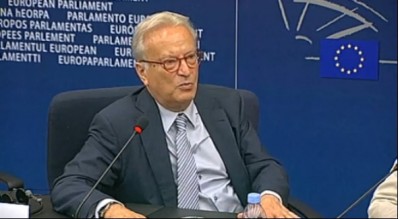
- The President of EU Parliament's Socialist Group, Johanes Swoboda from Austria, after having initially asked "EuroFora" to clearly confirm "to whom did you put the Question ?", "briefly" replied in a way obviously giving a Priority to Financial over Political matters :
- "We are the European Union. And the EU has Europeran Institutions : The Council (of Member States' Governmenments), The Commission, and the Parliament ", he stressed, Distinguishing between Governments and MEPs, from the outset.
- "We (EU Parliament) want Decisions and Legislation. We are not for the Fiscal (?) Treaties, (the way some name the New "€uroArea" Treaty, which, in fact, extends further than that : See "EuroFora"s relative March 2012 NewsReport's analysis). Because they are 2nd Best or, 3rd Best Solutions", as Swoboda estimated that.
- "It's absolutely Clear : We absolutely need EU Institutions" and Economic Solutions, a"nd that is what we are for, and that's what we did Today : We Fulfill our Obligations, This is, I think, the Important Element", he stressed.
+ "And, then, we can think about" the rest, "See : I am for Political Union. But let's, First, do the job, to Help create Jobs for EU Citizens, and Reduce the Debts. That's the most important", the President of EU Parliament's Socialist Group stressed in conclusion of his Reply to "EuroFora"s Question.
I.e., as he observed earlier, his Group apparently distinguishes as separate the issue about -"if you have a Political Union in 3 orth 10 Years Time", and prefers, Today, for EU Parliament to "Force them (EU Counciil of Governments) to give concrete answers , to say ... "Yes" or "No" to the Mutualisation", of EU Member States' Debts, as he put it bluntly.
--------------------
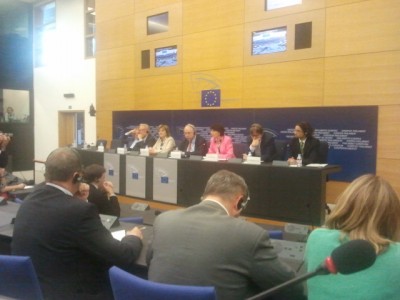
Indeed, Swoboda was topically speaking in a joint Press Conference together with Leaders from the 4 Bigger Political Groups, (ChristianDemocrats/EPP, Socialists, Liberals and Greens), as well as EU Rapporteurs Jean-Paul Gauzes from France and Elisa Perreira from Portugal, on an EU Parliament's Resolution where a Majority of MEPs supports the idea of a kind of "Mutualisation" of EU Member States' Debts through the creation of a "Redemption Fund".
- The proposed Mechanism will take into account EU Member State's obligation to work towards Balanced Budgets, since only those Countries which would have adopted some adequate Deficit - Reduction Measures would be elibible for eventual Financial Help from that Fund, observed on this occasion the President of EU Parliament's Liberal Group, former Prime Minister of Belgium, Guy Verhofstadt.
------------------------------
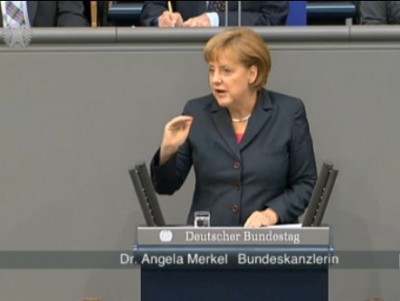
But Merkel's recent proposal to advance, in parallel, towards a necessary EU Political Union, surrfaced initially at the beginning of June, and the move was made even stronger Today, with the German Chancelor's speech at the Bundestag, where she reiterated her commitment to fight for EU-wide "Comptetitiveness"' strengethening and "Debt Reduction", as well as for a Sustainable Growth, financed otherwise than with more Debts, but also launched a call in favour of the "truly Historic Task" to build", step by step", a Political Union in Europe "on Sound Foundations", for which, the New "€uroArea" Treaty signed by 25 EU Member States last March in Brussels is just a necessary "1st Step", towards "more Monitoring" by "Independent European Organizations", "more Innovations, less Bureaucracy, towards completing the Common Market and creating a Labor Market" throughout the EU, "restoring Trust", (etc), "not because Markets asked for that, but for a Better Future for our (EU) Citizens", as she stressed.
Adopting an Historic viewpoint, Chancelor Merkel reminded that, more than "20 Years ago", in the Past, when the €uroZone "Monetary Union" was prepared, EU had also discussed about preparing even a "Political Union", but this was subsequently droped, meanwhile.
"EuroFora" remembers well, however, that, during a landmark, Historic Debate on "the state and Future of Europe", at EU Parliament in Strasbourg, back on 1995, i.e. when the Foundations of €uroZone were practically prepared, a main point stressed was that €uro common Currency would be only a 1st Step towards more European Integration, because the Trahsfert of Competences, from National Governments to a Central European Bank, on Monetary Creation, (one of the main Tools for Keynesian Policies against Cyclic Economic Crisis, in addition to stimulation by provisional Budgets' Deficits and Debts), would inevitably provoke, sooner or later, such Contradictions, that many Peuple would start to ask to create also an EU Governance, with a Political Union, as a necessary complement for the overall Coherence, and the good and proper funnctioning of European mechanisms.
=> This has become obvious Today, when a kind of Mutualisation of €uroArea Member States' Debt seems necessary, in order to efficiently face Markets' pressure, but also impossible, unless there is also a kind of Political Union forged meanwhile : Otherwise, why should, (and how could they afford it, in the long run), currently Stronger Economies "pay" for the Safeguard of Weaker Economies inside €uroArea, if they weren't able not even to Monitor the Expenditure, i.e. how their Money would be spend in practice by other Countries ? For all those reasons, experienced Politicians and/or Experts, as f.ex. the famous long-time Minister for Economy in Italy, Tremonti, had already told "EuroFora", during an International Conference in Paris, back on January 2011, that, in his view, "the Global Crisis has outpassed National States, so that a European Federation has now become necessary".
This appeared to be the Horizon towards which Sarkozy and Merkel had already started to lead the EU, at least since the pro-"Integration" movement, strongly initiated at the nearby Freiburg Franco-German Summit of December 2010 (See "EuroFora"s NewsReports from Freiburg and Offenburg, then). But, even if Hollande himself didn't initially seem to be against a deeper EU Integration at its core, nevertheless, it's also an astonishig fact that both his former Campaign Director, and current French Economy Minister, Moscovici, when he had spoken at an April 2012 Conference in Strasbourg, as well as his EU affairs Ministee Cazeneuve, on May 2012, have both apparently opposed any important Political boost for EU Institutional Reforms during the next 5 Years or so... A paradox, compared to France's traditionally pro-Instituitional Power stance, which might be tackled soon, particularly in view of a crucial forthcoming EU Summit in Brussels at the End of June.
In this regard, it's true that any eventually important Transfert of National Competences towards an EU and/or €uroArea level, must be necessarily accompagnied also by a series of seriously innovative and genuinly Democratic solutions in EU Citizens' more active and efficient Participation in the EU Decision-making, (f.ex. also by revigorating and developing Projects as that of "EuroFora", etc).
-------------------
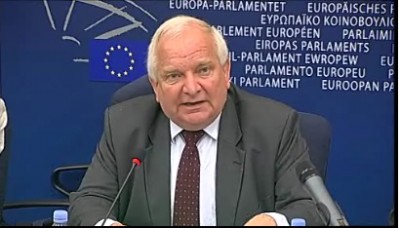
- "On the issue of (EU) Political Integration : I've already said, since several Months, and Governments such as that of Angie Merkel also said, that we won't get Europe out of the (Global) Crisis without a Strong Political Unio", stressed yesterday in Strasbourg the President of EU Parliament's biggest Group, that of ChristianDemocrats/EPP, Joseph Daul.
- In particular, we need to "share the Budgetary, Fiscal and Social Competences", i.e. to develop a joint (EU) "Economic Governance Sovereignity", he pointed out.
+ "But" this must be done "also with a Community method", went on to add from the outset Daul, energetically condemning as "Unacceptable" a reported move by the EU Council to marginalize EU Parliament on so delicate and EU Citizens-related issues as "Shengen''s system for Free Movement and Security, apparently because some mostly intermediary Bureaucrats attempt to push aside MEPs Democratically Elected by European People, as he denounced. On the contrary, EU Parliament's President must be regularly represented in all EU and €uroArea Councils, together with Heads of State/Governments in all their Summits, Daul also stressed, vowing to "Fight" against adverse moves, that he denounced as Anti-Democratic.
=> In fact, "we (EPP Group) agree and support German Chancelor Angie Merkel's stance on the need to advance towards a Political Union in Europe", clearly stressed, meanwhile, Today to "EuroFora", President Daul's Press Spokesman, and Deputy Secretary General of EU Parliament's biggest Group, that of ChristianDemocrats/EPP, Antoine Rippol.

+ In this wider context, President Daul's and all our Group's most topical and stronger reaction this week is against the astonishing attempt by some inside the EU Council of States to exclude EU Parliament in so important matters as that of Shengen, confirmed earlier to "EuroFora" the experienced Press Director of EU Parliament's biggest Group, that of ChristianDemocrats/EPP, Robert Fitzhenry from Ireland, (forthcoming EU Chair from January 2013).
=> That's why Daul has just anounced, earlier this week in Strasbourg, that EU Parliament's Biggest Political Group (without which No Majority can be normally found on EU Integration issues, and other core Decisions) will Suspend any cooperation with the current Danish EU Council's rotating Chairmanship, (unless it changes its Strange proposal to exclude EU Parliament f.ex. from Shengen a.o. EU Decision-making), so that MEPs will simply Wait until July for the start of the forthcoming Cyprus' EU rotating Chairmanshim (July - December 2012), which looks better disposed for a close cooperation with EU Parliament, as he said.
A move which obviously raises even more Questions, inter alia, also on the particularly "Hot" issue of Turkish Government's pressure on the EU to yield on "Shengen"'s Visas for massive movements of Turkish immigrants throughout the EU, (Comp. other "EuroFora"s NewsReports of this week), on which, EU Commission and EU Council might be reportedly enclined to give way, but probably not EU Parliament's MEPs, who have to renew their Electoral Mandate by fresh People's Votes in almost 1 Year... An issue notoriously linked also with EU's Identity and need for Popular support from EU Citizens if EU is going to really evolve into a Political Union in the foreseeable Future...
***
("DraftNews", as already sent earlier to "EuroFora"s Subscribers/Donors. A more accurate and Full, final version, may be published asap).
***
Main Menu
Home Press Deontology/Ethics 2009 Innovation Year EU endorses EuroFora's idea Multi-Lingual FORUM Subscribers/Donors FAQs Advanced search EuroFora supports Seabird newsitems In Brief European Headquarters' MAPs CoE Journalists Protection Platform
BRIEF NEWS
- 00:00 - 02.06.2021
- 00:00 - 18.10.2020
- 00:00 - 19.06.2020
- 00:00 - 18.05.2020
- 00:00 - 20.04.2020
- 00:00 - 02.02.2020
- 00:00 - 09.12.2019
- 00:00 - 27.11.2019
- 00:00 - 16.11.2019
Popular
- Yes, we could have prevented Ferguson riots says World Democracy Forum's Young American NGO to ERFRA
- Spanish People Elect CenterRIGHT Majority with 1st Party and Total of 178 MPs (6 More than the Left)
- Pflimlin's vision
- The European Athletic "Dream Team", after Barcelona 2010 Sport Championship Results
- Source Conseil d'Europe à ERFRA: Debatre Liberté d'Opposants à Loi livrant Mariage+Enfants à Homos ?
- Head of BioEthics InterGroup, MEP Peter Liese : "Embryonic stem cell research reaching its END" !?
- Spain: Jailed Turkish Terror suspect with Explosive,Drones,Chechen accomplices stirs Merah+ Burgas ?
- UN Head Ban Ki Moon at CoE World Democracy Forum : - "Listen to the People !"
Latest News
- Test Photos (f.ex.+ Invit to EU + Korea Peace meeting)
- EUOmbudsmen Conference 2022: Digital Gaps affect People's Trust threaten EF Project on EU Future ?
- French Election : Black Out on Virus, but Obligation for Fake 'Vaccines" Challenged
- Both French Presidential Candidates point at "Humanism" in crucial times...
- France : Zemmour = Outsider may become Game Changer in Presidential + Parliamentary Elections 2022
Statistics
Visitors: 63574934Archive
Login Form
Syndicate


Other Menu
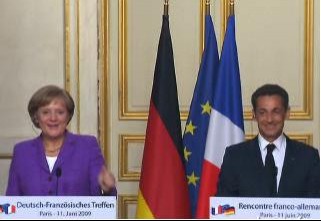
The official presentation of a "Program" respecting People's choices voted in the June 7, 2009 EU Elections, to be debated in EU Council and EU Parliament during its 1st Session on July in Strasbourg, is the No 1 Priority, according to Democratic principles, for the Franco-German axis, said the main winners at the ballot box, French President Nicolas Sarkozy and German Chancellor Angie Merkel.
They stressed that the New EU Commission's President must have a "Program" in favor of an EU which "protects" its Citizens, regulates financial markets and aims at a "Political" Europe" : a wording they have used as incompatible with Turkey's controversial EU bid.
They also declared ready for a "political" endorsment of "Mr. Barroso's candidacy" in June's EU Council, considering that an official decision would have to be made after EU Parliament's debates and votes, possibly from next month (July), with the legally necessary final acceptance shortly after Lisbon Treaty's entry into force, hoped for September or October.
- "A Program, and Mr. Barroso" : This resumes, in substance, the anouncements made by Sarkozy and Merkel, on the question of current EU Commission's President, Barroso's declared wish to succeed to himself for a second mandate, to be extended during the following 5 years.
In their 1st meeting after EU Elections, they observed that "the Franco-German axis counted in European Elections' campaign... But, we both keep a realistic view : We saw the number of those who abstained, and we must absolutely give them an answer. We also see the disilusionment of an important number of Europeans vis a vis Europe, and we are aware of the responsibilities we have".
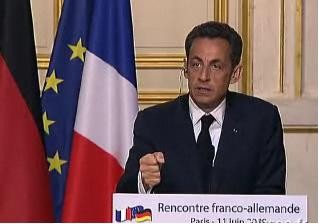
- The "Duty" of the new EU Commission's President, after June 7, 2009 EU Elections' result, "is to act for a Europe which protects the Europeans, to commit himself into working for a better Regulation of Financial transactions, ... and to have a Political will for Europe", underlined Sarkozy.
Therefore, "we have asked M. Barroso... to clarify, to officialy present the intentions he has", he anounced.
- "We want to speak also about the Programme", explained Merkel.
- "It's important that for the next EU Parliament's mandate (2009-2014) we take the right Decisions for Europe. Obviously on Persons, but mainly Decisions on Issues", she stressed.
- "It's not simply a question of a Person, it's also a question of a Programme". We are "really asking Mr. Barroso to commit himself on a Program, and on Principles, on Values", Sarkozy added.
EU President-in-office, Czech Prime Minister Jan Fischer, accepted the Franco-German stance :
- "Barroso must present his Programme. The Czech Presidency agrees with that", Fischer reportedly said later, after meeting Sarkozy.
But Press reports from Brussels claimed that Barroso had preferred to be officially appointed by EU Council since June, (i.e. next week), "because this was implied by the current Treaty of Nice, according to him", and considered any delay until the possible ratification of the new, Lisbon Treaty on September/October, as "undemocratic".
- "At any case, independently of what Germany and France ask, it's also EU Parliament's wish". "We shall propose Mr Barroso's candidacy... But even in the framework of Nice Treaty, EU Parliament has to be associated in this Decision", the French President observed.
If this is correctly done, then "we support Mr. Barroso's candidature", and "if the (EU) Parliament agrees, we might ratify this decision since July", (i.e. next month), they both said.
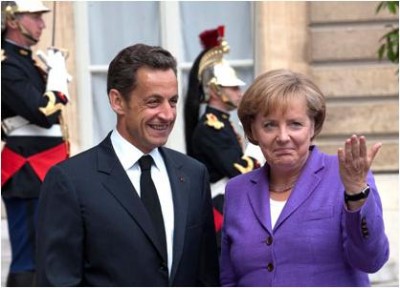
- "France and Germany support Baroso's candidacy, But we want to speak also on the Program. We believe that this Program should be established in close cooperation with EU Parliament, and that's why we have followed an appropriate way", said Merkel. - If EU Parliament wants, this election can take place on July, but this must be done in full agreement.
- "We shall support Mr. Barroso's candidacy, without doubt", said Sarkozy. "But we have asked from Mr. Barroso, as I told him yesterday, to put into detail.. his intentions, at the eve of his 2nd mandate, if the situation avails itself.
France and Germany "don't want to take an Official Legal Decision by writting" during "the next (EU) Council" (on June 18-19), declared Sarkozy. Because they prefer, at this stage, only "a Political decision" on June, "so that we (EU Council) can work together with EU Parliament", which starts to meet only Next Month, since July in Srasbourg, "leaving a Legal decision by writting for later".
- "If the Conditions are fuillfiled in EU Parliament, we (EU Council) are ready to give the agreement and make it offficial", said Merkel
- "But, now we are working in the base of Nice Treaty. If tommorow we want to work in the spirit of Lisbon Treaty, we have to find a proper way", she added.
- "Of course it's Legally complicated, because we are going to make a Political proposal to the forthcoming Council, for an EU Commission's President, on the basis of Nice Treaty : So, we (EU Council) will not appoint the Commissioners. Only the President. If EU Parliament agrees, it could endorse this position on July", explained Sarkozy.
But, on Autumn, "if Ireland ratifies Lisbon Treaty, there will be, at any case, a 2nd Decision, to appoint the Commission's President, this time on the basis of Lisbon treaty, and then, we, the EU Member States, would have to appoint (also) the EU Commissioners", he added.
As for the precise Timing : - "Everything is suspended until the Irish vote... Now, we must all make everything possible to help Ireland to say "Yes"" to Lisbon Treaty... The Irish Referendum, ..will take place either on September or on October. It's a Question which depends on the Irish. And, then, we shall have the Choice of the Candidates for the permanent Institutions of Europe".
However, "if Ireland says No, we, French and Germans, have to assume our responsibilities, and we'll do so", he concluded.
But British and Swedish governments were reportedly eager to have a final EU Council decision on Barroso since this month, on June's European Council. While the other EU Member Countries are divided, several of them preferring to wait until EU Parliament pronounces itself, on July, and/or until Lisbon Treaty might be ratified by Ireland at the beginning of the Autumn. Barroso's current mandate ends on November.
There are also various, contradictory and/or unpredictable reactions inside EU Parliament vis a vis Barroso's wish to continue a 2nd mandate, because many MEPs are openly or secretly opposed, reluctant, or hesitating.
In the biggest EU Countries, as France and Germany, EU Citizens voted on June 2009 EU Elections for a renovated, non-technocratic but Political Europe which cares for its Citizens, with an Identity, Values and Borders, declared incompatible with Turkey's controversial EU bid, by mainstream, pro-European Governing Parties. Similar choices were also supported in several other small or medium EU Countries.
On the contrary, whenever, in other Countries, Governing and other mainstream Parties didn't make these choices or eluded them, EU Citizens massively voted for euro-Sceptics whenever they were the only ones to to promise anti-bureacratic change and oppose Turkey's demand to enter into the EU, (f.ex. in the UK, Netherlands, etc).
It's seems to be an Open Question whether Sarkozy and Merkel's conditions will be really accepted by Barroso, who was appointed on 2004 in a different political context, (with Socialist Prime Ministers in Germany, France, etc), had rejected in the Past the idea of EU becoming "equal to the USA" as "ridiculous", and pushed for Turkey's contoversial EU bid, trying to "soften" or contain the changes desired by the People who voted for Merkel and Sarkozy with another policy vis a vis Turkey on 2005 in Germany and on 2007 in France, as they did all over Europe on 2009.
In addition to many EPP Governments, it's 3 remaining Socialist Prime Ministers : Gordon Brown in the UK, Zapatero in Spain, and Socrates in Prortugal, who support Barroso, as well as Liberal Swedish Prime Minister Reinfeldt. But their Parties lost the June 2009 EU Elections.
Questioned whether there was still "Time" for "other" possible "Candidates", Sarkozy and Merkel did not deny, nor made any comment on that, but simply said that "it's not for us to make publicity for any candidates. We anounced our choice ("A Program, and Mr. Barroso"). But we respect any other candidate".
Among various other names cited are former Belgian Prime Minister Verhofstadt, former UNO's Human Rights Commissioner Mary Robinson of Ireland, Italian former EU Commission's vice-President Monti, etc. Meanwhile, Luxembourg's PM Juncker, (who had been unanimously accepted by EU Council for EU Commission's Presidency on 2004, but refused), announced his intention to resign from "EuroGroup"'s Chair. Thus, he might be available for another Top EU job.
As "EuroFora"'s "opinion" said (See publication dated 9/6/09) : - "If the current candidates (i.e. Barroso, etc) to the Top EU jobs promise and guarantee to respect People's democratic choices, then, it's OK".
"Otherwise, Europe must find new candidates, really motivated and able to implement these democratic choices of the People."
Because, "in Democracy, the forthcoming choices for EU's Top Jobs,...should be made according to EU Citizens' Votes in June 7, 2009 European Elections, and main EU Governments' strategic policies".