


 newsitems ECB Spokeswoman Schuller to EuroFora: Trichet sticks to Growth Forecasts revised Upwards +Innovation
ECB Spokeswoman Schuller to EuroFora: Trichet sticks to Growth Forecasts revised Upwards +Innovation


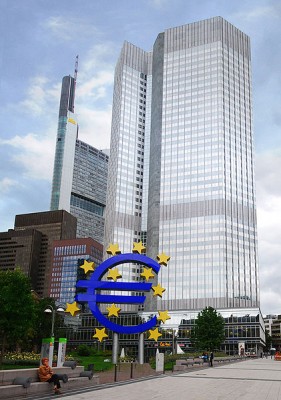
After ECB recently "revised Upwards" its Forecasts for EuroZone Economy's Growth in 2010 and 2011, and pointed at Innovation as main driver, it didn't change, nor issued any new forecasts, ensured "EuroFora" ECB's Press Spokeswoman, Regina Schüller, in reaction to some controversial interpretations of ECB's chief, Jean-Claude Trichet's statements at nearby Frankfurt on Thursday, which apparently misguided some people provoking irrational moves at certain Stockmarkets.
ECB's latest Report forecasts an EuroZone Growth up to "+1.5% in 2010, and .. + 2.2% in 2011", while it points at "Innovation" as EU's way out of the Global Crisis, citting recent Facts which give it a crucial importance for EuroZone's "return to Growth" to catch up with the US, Japan or China, etc. But it falls short from saying how this aim could be achieved, at the moment that EU prepares for a stronger Innovation-driven 2020 Economic Strategy.
Meanwhile, US and Japan seem to grow even faster than the EU for the moment, but this appears due to classical Consumer Stimulus, "Temporary" measures (boosting fex. Car and House sales, etc), while EU's stimulus policies apparently focus more on productive investment for modern activities, due to catch up with the US in the Future with a stronger, renovated European economy.
Previous "soft" EU economic policy, known as "Lisbon Strategy", notoriously failed to push RST spending to 3% of EU's GDP.
All this makes it even more urgent now, to find new ways to stimulate and planify EU's RST and Innovation policy, in the framework of a new "2020 Strategy" due to be prepared during the incoming Spanish EU chairmanship, which will debate its Programme at EU Parliament next week in Strasbourg with Spanish Prime Minister Jose Zapatero, in the run upo to an exceptional February 2010 EU Summit, convoked by EU Council's President, Herman van Rompoy, (together with the Environment/Climate issues), in view of final Economic policy Decisions at the Spring 2010 EU Council on March.
- "In his statements made on Thursday", Jan. 14, 2010, "the (ECB's) President (Jean-Claude Trichet) simply referred to the Forecasts published at the end of 2009 (See above). There are No New forecasts" now, ascertained "EuroFora" the Director of ECB's Press Service, Spokeswoman Regina Schûller. On Economy, "next forecasts are due on March" 2010, she added.
ECB "revised Upwards" its earlier "projections" for "the range for 2010", according to its latest Report, published at the end of 2009. It observed that "economic activity in the euro area improved further in the 3rd quarter of 2009, with real GDP growth returning to positive territory", "by 0.4% quarter on quarter", according to Eurostat’s first estimate", while "available survey data suggest that the recovery continued during the 4rth quarter of 2009" also.
"Eurosystem staff project annual real GDP Growth of between ..+0.1% and +1.5% in 2010, and between +0.2% and + 2.2% in 2011", ECB's Report issued on 29.12.2009 said..
+ Moreover, "there may be stronger than anticipated effects stemming from the extensive macroeconomic Stimulus being provided and from other policy measures taken".
"Confidence may also improve further, and Foreign Trade may recover more strongly than projected", it added.
"At present, the Euro area is benefiting from ...a recovery in Exports, as well as from the significant macroeconomic Stimulus under way and the Measures adopted to restore the functioning of the Financial system", added to "the inventory cycle", ECB observed, showing the success of EU Countries' economic recovery plans.
But it warned EuroZone to advance carefuly, because "activity is likely to be affected ... by the ongoing process of Balance sheet Adjustment in the financial and the non-financial sector" also "Outside the Euro area", (fex. in the USA, Japan, etc). And it advised to keep an eye on "a number of the supporting factors (which) are of a Temporary nature" (fex. the Stimulus poliies), for eventual "renewed increases in Oil and other commodity prices, ..intensification of Protectionist pressures, and possibilities of disruptive Market movements related to the correction of Global imbalances". I.e. mainly because of External factors, where "risks" look "largely balanced".
_______
In EuroZone, "Inflation is expected to remain Moderate over the policy-relevant horizon, with overall price, cost and wage developments staying subdued in line
with a Slow Recovery in demand in the euro area and elsewhere", but even better than ECB's "aim of keeping inflation rates below, but close to, 2% over the Medium term" : Indeed,"the December 2009 Eurosystem staff projections foresee annual HICP inflation of (only) 0.3% in 2009, between 0.9% and 1.7% in 2010, and between 0.8% and 2.0% in 2011", it ensured.
But, "several countries will have to start (Fiscal) Consolidation in 2010, and all others in 2011 at the latest", ECB observed, hoping that "increases in indirect Taxation and administered prices" wil not "be stronger than currently expected", and that Global "Commodity Prices" (fex. on Energy) will remain moderate.
-----------------------------
On "developments in the World Economy", ECB foresees "a further Expansion in Global activity", according to "the latest indicator-based evidence".
Already, "the return to Growth in Global Economic activity has also coincided with a recovery in World Trade""the World Economy", ECB added.
F.ex. "the Output Index reached ...a Level which represents the Highest reading since late 2007", ("54.2 in October 2009, up from 53.2 in the previous month), while "the overallGlobal Purchasing Managers’ Index (PMI) has continued to increase over recent Months, movingwell above the expansion/contraction threshold".
"Manufacturing remained the main driver of Growth, but Services also continued to indicate an Expansion. The Recovery in Global Manufacturing continued in November, for the 5th Month in a row, and remained rather Broad-based", ECB noted.
This attests a "gradual" "return to Growth in the major emerging markets, as well as in a number of advanced economies" : "The contraction in Global growth in the last quarter of 2008 and the 1st quarter of 2009 was followed by Positive Growth in the 2nd and 3rd quarters of 2009'".
"At the same time, Global Inflation rates have remained Low. In the OECD countries, headline CPI rose (only) by 0.2% in the Year to October" 2009, and ECB attested a "Downward pressure on Prices in recent Months".
-------------------------
But "in the United States .... real GDP increased by 2.8% in annualised terms in the 3rd quarter of 2009", ("compared with a contraction of 0.7% in the 2nd quarter"), "economic conditions improved and activity recovered", "according to the Bureau of Economic Analysis".
However, the US "Pick-Up in economic activity reflected an increase in Consumer spending", which was added to "a strong rebound in Residential investment and Exports", as well as to "a less pronounced pace of inventory liquidation". Indeed, the American Government Stimulus Measures temporarily supported Private Demand, particularly in the Auto and Housing sectors", ECB observed.
An equivalent difference to European policies is seen "in Japan", where "the pace of economic activity picked up in the 3rd quarter of 2009, (while Consumer Prices continued to decline)" : "quarterly real GDP grew by 1.2% in the third quarter of 2009, corresponding to the Highest quarterly Growth rate in more than two Years" !
Here too, as in the US, "GDP growth in the third quarter of 2009 was mainly supported by Domestic Demand", which was added to "net Exports". "The Recovery was supported by the Fiscal Stimulus package" of the Japanese Government, after which, "Consumer Spending rose by 0.7%", and "Firms’ investment increased for the first time in six quarters, by 1.6%". "However, Residential Investment continued to fall sharply", and "looking ahead, the pace of improvement in economic activity is likely to be more Moderate" in Japan.
The point became obvious in "China, (where) annual GDP Growth accelerated to 8.9% in the third quarter of 2009... Fixed Asset Investment growth, driven mainly by the Fiscal package, contributed 7.3 % points to GDP Growth (which stood at 7.7% overall) .. from January to September....Private sector Investment also started to pick up, mainly driven by ..the Real Estate sector. The contribution from Consumption to GDP growth remained robust, at 4% points from January to September". But, already, in China "the contribution of net Exports was negative, however, and the Trade Surplus decreased to 4.3% of GDP .. from January to September 2009, from 6.1% in the same period last year (2008). The decline in the Trade Surplus was caused by a rapid Recovery in Imports, in turn boosted by ...an increased Demand for Imported commodities. The recovery in Exports was considerably Slower", ECB observes for China.
To face such a rising Global Competition, Europe obviously needs to act fast and succeed to catch-up in healthy and sustainable Growth with the US, Japan and/or China etc. in the medium and long term, thanks to EuroZone Government's preference to stimulate less Consumers' Demand and more Productive Investement in Strategic areas of High Technologies for the Future :
>>> Therefore, in the EU, "Policies that enhance Competition and INNOVATION are ...Urgently needed to speed up restructuring and Investment and to create New business Opportunities", stressed in conclusion ECB's latest Report.
Because, "most estimates indicate that the (Global) financial Crisis has reduced the Productive capacity of the Euro-area economies, and will continue to do so (at least) for some Time to come", according to ECB. That's why, in addition to the traditional remedy of "Labour market Flexibility and more effective Incentives to Work", "In order to support sustainable Growth and Employment", EU has to "Urgently" focus on "Policies enhancing Innovation".
---
Moreover, at another ECB paper on EU's 2020 Economic Strategy, issued on Thursday, Jan. 14, 2010 at nearby Frankfurt, ECB stresses that "Policies that enhance competition and Innovation are Urgently needed to speed up restructuring and Investment, and to create the Productivity gains necessary to overcome past weaknesses. This would allow European countries to remain competitive in an increasingly interconnected, Global economy".
Therefore, ECB "agrees" with EU Commission on "the importance of Research and Innovation for stimulating Productivity gains", among "key" issues to an "EU 2020 Strategy".
In parallel, remains also a need for "sound Institutions supporting appropriate Wage-setting, facilitating job Mobility and matching in Labour markets and creating incentives to work", i.e. "the establishement of efficient and Flexible Labour Markets", according to EU Commisssion), which "are required to attain high levels of Employment and labour Participation", ECB added, asking both for a "greater Flexibility in the EU economy and an enhanced Governance framework".
( ECB faced its 1st Global Crisis since the foundation of EuroZone, shortly after it celebrated its first Decade with an exceptional Summit in Frankfurt on 6.2008)
* In doing so, "the 300 million Citizens' strong Monetary Watchdog, has (also) to keep a Unified policy for 16 EU Member Countries, more or less advanced on Structural Reforms, Trichet said on Thursday.
But, "Europe, ...compared ..with the US", has "more or less the same order of magnitude of standard Deviation" "at various indicators such as Growth, Inflation, unit Labour cost evolution", as "very Vast Single economy of more than 300 million Citizens", he observed.
Apparently, such local differencies should be taken into account when considering Trishet's estimation that, "for some Time to come .. it's "likely" that "Unemployment in the Euro-area is expected to increase somewhat further", while the .. Economy is expected to Grow only at a Moderate pace in 2010", as he said.
In EuroZone, ECB's Chief confirmed that "as an average for .. (the) year (2010), the mainstream of experts and analysts, as well as our own staff, is projecting slightly Positive Growth" : "We have a Period in front of us which is, fortunately, in black figures (i.e. with Positive Growth)", he ensured.
To a Question if he "see(s) any risk at all of a set back of the euro zone’s recovery in the 1st Quarter" of 2010, Trichet replied that, "as we have frequently said", ECB "do(es) not exclude that "we could pretty well have a rate of growth from quarter to quarter that would go up and down" : "we have a Bumpy road ahead of us”. "Since the start of the black figures" (i.e. of Positive Growth), we have never claimed Victory. We have always said we have to remain alert and prudent", he advised.
------------
But ECB's Chief was clearly Optimist on Inflation : "We see ...No Risk for a destabilisation of our Prices. Uncertainty and risks in both directions ..are balanced". ECB's decisions have "permitted us to anchor, very Solidly, inflation rate expectations ..in all circumstances, including in very difficult circumstances like today", he boasted.
"We expect Price Stability to be maintained over the Medium term, thereby supporting the Purchasing Power of Euro-area Households", ECB's chied reiterated.
----------
To a Question on "Financial System Reforms", touching upon Global Governance, Trichet replied that "we did our job properly in the past because we took very Bold Decisions and avoided depression. It is extremely important that all the economic agents realise the seriousness of the situation we would have had without the Rapidity and the Boldness of the Decisions taken by the ECB and other central Banks or the decisions of our Governments"
"But again, this is no time for complacency. We have a very hard job ahead of us", ECB's chief warned. "We cannot afford to have a Fnancial system which is as fragile in the Future as it has proved to be in the Past. Our Democracies in particular would not accept that. ...So we are obliged to find appropriate ways for making the (Financial) system more Resilient", "we are called upon to reform the financial system", he stressed, reminding also the recent job done in several ways, fex. through "the ECB, "the Financial Stability Board", "the Basel Committee", and "the G20", "the International Community", etc., in "enlarging Global Governance".
Main Menu
Home Press Deontology/Ethics 2009 Innovation Year EU endorses EuroFora's idea Multi-Lingual FORUM Subscribers/Donors FAQs Advanced search EuroFora supports Seabird newsitems In Brief European Headquarters' MAPs CoE Journalists Protection Platform
BRIEF NEWS
- 00:00 - 02.06.2021
- 00:00 - 18.10.2020
- 00:00 - 19.06.2020
- 00:00 - 18.05.2020
- 00:00 - 20.04.2020
- 00:00 - 02.02.2020
- 00:00 - 09.12.2019
- 00:00 - 27.11.2019
- 00:00 - 16.11.2019
Popular
- Yes, we could have prevented Ferguson riots says World Democracy Forum's Young American NGO to ERFRA
- Spanish People Elect CenterRIGHT Majority with 1st Party and Total of 178 MPs (6 More than the Left)
- Pflimlin's vision
- The European Athletic "Dream Team", after Barcelona 2010 Sport Championship Results
- Source Conseil d'Europe à ERFRA: Debatre Liberté d'Opposants à Loi livrant Mariage+Enfants à Homos ?
- Head of BioEthics InterGroup, MEP Peter Liese : "Embryonic stem cell research reaching its END" !?
- Spain: Jailed Turkish Terror suspect with Explosive,Drones,Chechen accomplices stirs Merah+ Burgas ?
- UN Head Ban Ki Moon at CoE World Democracy Forum : - "Listen to the People !"
Latest News
- Test Photos (f.ex.+ Invit to EU + Korea Peace meeting)
- EUOmbudsmen Conference 2022: Digital Gaps affect People's Trust threaten EF Project on EU Future ?
- French Election : Black Out on Virus, but Obligation for Fake 'Vaccines" Challenged
- Both French Presidential Candidates point at "Humanism" in crucial times...
- France : Zemmour = Outsider may become Game Changer in Presidential + Parliamentary Elections 2022
Statistics
Visitors: 67385044Archive
Login Form
Syndicate


Other Menu
*Paris/ACM/12 October 2008/-
When Europeans really feel a vital need to urgently launch common replies to challenging World Crisis, as the present Financial turmoil of Global Markets, they forge new decision-making tools and new dynamics :
The 1st in History EuroZone Heads of State and Government Summit, organized in Paris at the invitation of French President, and current EU chair, Nicolas Sarkozy, with the participation of 15 national leaders and EU institutions' chairmen, partly enlarged to British Prime Minister Gordon Brown, after a highly symbolic duo with German Chancelor Angie Merkel, at General De Gaulle's birth-village, 50 Years after he welcomed there former German chancellor Adenauer (1958-2008), may have not one, but two results :
- The first, and more urgent, was to launch an "ambitious", "coherent", and "efficient" common European movement, able to stimulate "solutions" to the World Economic Crisis, as Sarkozy anounced from the outset : State Garantees (to new Bank debts up to 5 years), fresh Capital input (f.ex. by buying shares), support to distressed banks, (while also restructuring them), incite the European Central Bank to facilitate commerial bills europe-wide, etc.
"Acting swiftly", from tomorrow, national measures will quantify all these targets, with coordinated actions from all EuroZone's Governments : France, Germany, Italy and others, decided to anounce, at the same time, such concrete measures, according to agreements that we have already made all together, revealed Sarkozy at the final Press Conference, flanked by EuroZone's chairmen : EuroGroup's Jean-Claude Juncker, and Central European Bank's Jean-Claude Truchet, as well as EU Commission's Jose Baroso, to solemnly stress the will to find common European solutions.
- "United and Determined, all EuroZone's Countries will act to prove that Citizens can Trust" the Economy, Sarkozy concluded. If we attract also all EU's 27 countries, Wednesday in Brussels, then we can coordinate action with our American Friends at a Global level, he anounced.
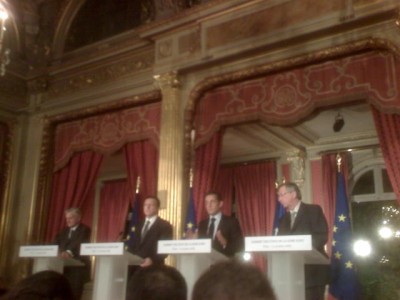
- "With this new Toolbox, we do not want to serve Bankers, but to work for Europe and its Citizens' interests", added Juncker.
- "For the moment, we want to act urgently to regulate the Crisis. But the time will come when those responsible for this, will have to account for their actions. Yes to real Capitalism, No to Speculators. Those who abused, will face sanctions, Sarkozy warned.
Need stimulates activities which create new organs, say biologists, and Gordon Brown, compatriot of Spencer, the famous bio-Historian, would certainly not deny that, after his surprise visit to EuroZone's Summit in Paris, which attracted him one hour more than scheduled...
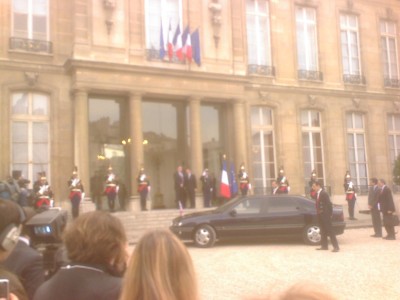
Decisions include also the creation of a Crisis-management European mechanism, which "requires constant Monitoring", as well as strengthening Economic policy cooperation between EuroZone's countries.
Sarkozy will be judged by History not just by the immediate Economic results, expected at the end of this week's decision-making proces at National and EU level, but also by the more far-reaching consequences at the aftermath of this Historic EuroZone 1st Summit : Will it succeed to become a precursor forging a New era in European institution's revitalization ?
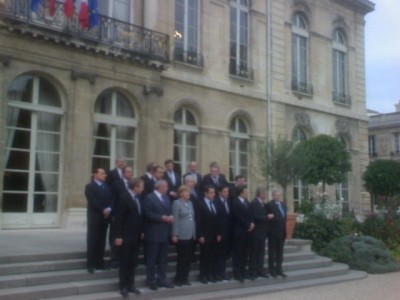
Significantly, the French President sat, during discussions, between German Chancelor Merkel, and British Prime Minister Brown, facing the chairmen of EuroGroup, Juncker, ECB : Truchet, and EU Commission, Baroso, with Prime Ministers of Spain, Zapatero (a hot partisan of EuroZone's Summit) at his right side, and Italy's Berlusconi, at his left, surrounded by Austrian, Belgian, Cyprus', Finland's, Greece's, and Ireland's leaders, as well as Slovakia's, Slovenia's, Portugal's, Netherlands', Malta's and Luxembourg's leaders.
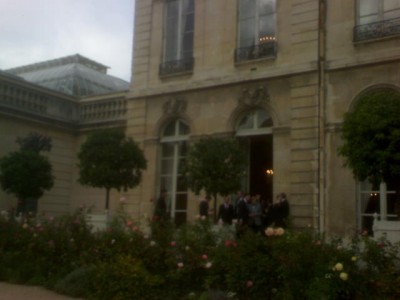
Meanwhile, those who tabled for a rift between French and German positions were faced with a smiling Merkel at De Gaulle-Adenauer's meeting place, a sunny Saturday morning, and a particularly active-looking Merkel inside the French Presidential Palace at Elysee's gardens on Sunday, (as happy few photographers discovered)..
- "De Gaulle's hilltop, at Colombey-les-2-Eglises, gave an astonishing overview to a huge landscape, entirely surrounded by splendid Nature, as far as eyes could see", said to EuroFora an obviously charmed German Journalist.
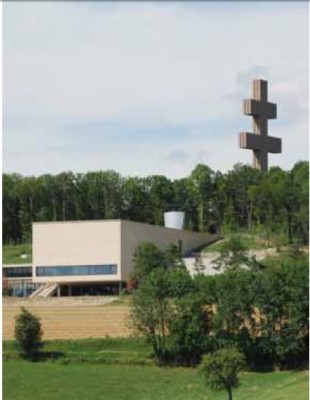
She was describing Saturday's inauguration of a High-Tech Memorial close to the Historic Giant Double Lorraine's Cross, built by famous Novelist Andre Malraux, to perpetuate the Memory of his famous call for "Resistance" to NAZI, and his vision for the creation of New Institutions and Franco-German reconciliation, to foster Europe's role in the World, also for the Future.

Children playing at Elysee's gardens before the Historic 1st EuroZone's Summit : What Europe's Future will look like ?