


 newsitems Austrian President Fischer to EF+MEPs on EU - Russia relations : Ready to help find Solutions
Austrian President Fischer to EF+MEPs on EU - Russia relations : Ready to help find Solutions


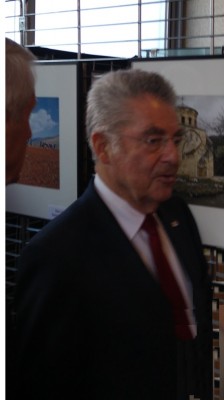
*Strasbourg/CoE/Angelo Marcopolo/- Experienced, twice Elected President of Austria, Heinz Fischer, Replying to a Question by "Eurofora" at the CoE, shortly after an Official Visit to Russian President Vladimir Putin and Foreign Minister Sergyei Lavrov,, took a Positive stance on the prospect for "Austria to Help the EU develop anew a Friendly Cooperation with Russia" in the foreseable Future, and referred us, for the rest, to what he had "already" said, earlier Today, during his official Speech and Debate with MEPs at CoE's PanEuropean Parliamentary Assembly.
- "I am all for Co-operation and for acting as a Bridge. I am a representative of a country that has good political relationships" with all sides, and "I think that progress can be made on negotiations on Crimea and the Minsk (Peace) process. That seems obvious to me". This includes also a possible exchange of prisoners, as, there too, "I do not rule out processes being set in motion that might lead us to where we want to be", he said earlier, with obvious voluntaristic optimism.
- Meanwhile, " it is our opinion that (EU-USA) Sanctions (on Russia) are not an end in themselves. Of course, it would be good if we can Create a Situation where Europe, United, can decide to Reduce or End the Sanctions. I believe, as the German Foreign Minister does, that we should think in a Step-by-Step way. ...My feeling is that, perhaps in 1 Year, (i.e. during 2017), the process of Reducing Sanctions can Start, but we are already further along than we were. That would be Fine", Fischer Highlighted.
- But, in order to achieve that, First of all, "it is Necessary to make Progress on the Minsk Agreement" (of February 2015. See the relevant "Eurofora" NewsReport: ....), and, for that purpose, "Both Sides must Contribute to such a development".
- In fact, "2 Years ago (i.e. on 2014), when CoE's "Assembly was discussing the temporary Suspension of the Voting rights of members belonging to the Russian Federation’s delegation ... because of the Ukraine crisis and the situation in Crimea", (i.e. initially a Compromise, which was smashed by a last-minute Amendment by a Minority Group adding even Exclusion from PACE's Leading Bodies, which provoked the Withdrawal of all Rusian MEPs), many expected "that the Crisis could be Overcome Swiftly", he pointed out. But, "Today, (i.e. on 2016), 2 Years down the road, Nobody can claim that this Problem has been Resolved", he regretted.
- However, "there are, if I may say so, some Glimmers of Hope. The Minsk talks have been a Positive Development. They have yielded some Results, or at least partial results. The extent of the Confrontation has been Curtailed, and there is Now a Lower Number of Casualties", Fischer noted, (even if some Civilian People reportedly continue to be Killed or Wounded, particularly at the Donetsk/Luhansk Autonomist Regions of Eastern Ukraine).
- Nevertheless, "the basic Root of the Problem is still Unresolved, so the situation is still Far from satisfactory – and indeed Dangerous", the Experienced Austrian President Warned. - And "my impression ...is that Russia can hardly be satisfied with the sanctions and the cooling of its relationship with Europe. At the same time, however, Russia is not – or Not Yet – prepared to pay a reasonable price for a solution. On the other side, Ukraine must be even more Dissatisfied with the present state of affairs, yet it is Not prepared to, or is not in a position to, pay a reasonable price to reach a Solution. By that I mean the exact Implementation of the Content and Chronology of the Minsk Agreements, and (particularly) the ability to Find a workable Arrangement of Self-Government", for the Autonomist Regions of Donetsk-Luhansk, in South-Eastern Ukraine, in line with the main Promisse for a Large De-Centralisation and a Special Status inside Ukraine, already made by its President, Pedro Poroshenko, as early as since his 1st Visit to the European Institutions, Starting by the CoE, back on June 2014, (Comp. relevant "Eurofora"s NewsReport, f.ex. on CoE's "Venice Committee"'s key role), followed and much further developed, in considerable depth and concrete details, by the February 2015 "Minsk" Agreements for Peace, officialy endorsed by both sides on the spot, under the auspices and with the signature of 4 Heads of State/Government from Ukraine, Russia, France and Germany, (Poroshenko; Putin, Hollande and Merkel. See : ....). According to those Minsk Agreements, all the Main Steps, from each side, as well as Dialogue and Settlement of more Concrete Pending Issues, should have approached Conclusions around the End of 2015, but this Rendez-Vous was obviously Delayed in real practice, at least for the Time being.
- But, "there is a corRelation between the Implementation of the Minsk Agreements on the one hand, and an End to Sanctions or at least the Gradual Lifting of Sanctions. ....we believe that this is an Incentive to work even harder towards the implementation of the Minsk agreements", he noted, as far as Russia is concerned. Moreover, "Ukraine and Russia are Neighbours, and I therefore believe that Co-operation is the only way forward ... relations. It will be Damaging to both If their Relations continue to be so Poor". On the Contrary, "it would be a Good thing for Russia and Ukraine if they Improved their relatons;....We live in an Age where All our Countries must Co-exist in Europe", he noted, as far as also Ukraine is concerned, (Comp. also Supra). And, even more Widely, "for me, it remains a basic premise that as far as Europe and Russia are concerned, it is Good, if we have Good Relations. I would also argue that it would be Bad for Europe and Russia, If our Relationship is Bad", the Austrian President stressed.
=> - "In order to Improve relations, we Need to Understand the Position of the Other Side. We need to understand the other. Russia needs to understand what it is that exercises its Partners in Europe (EU) – what we are Concerned about", (probably meaning mainly Territorial Integrity of EU States, in the Borders existing since the End of the 2nd World War : A Principle that Russian President Putin was Vainly trying to promote in a "Hot" Press Conference back on 2007, at the "G8" Heads of State/Government Summit at Heiligendam, Germany, on the occasion, then, of the quite Different, Kosovo Issue inside Serbia. But USA and most EU Countries apparently realized the Topical Importance of the Territorial Integrity Principle rather Later-on, after the 2008 Georgian and particularly the 2014 Ukranian Crisis. However, in that latest case, it was, obviously also another basic Principle of International Law whichhad been breached : that of "Non Interference in the Domestic Affairs of a Sovereign Country", as even Chinese President Xi Ping observed, during his 1st Visit to the EU, in a Press Conference in Germany, on Spring 2014).
+ "Conversely, Europe (EU) must understand what it is that Russia is concerned about, and has been concerned about over the past 25 years since 1991", (i.e. since theDislocation of the ex-URSS and even of its succcessor, the CIS). - In this regard, "My personal view ... is that a policy that would lead us, within the foreseeable future, to Ukraine’s Accession to NATO, is one that, for Europe (EU), Ukraine and Russia, would ultimately bring more Disadvantages than advantages", the Experienced, Twice Elected Austrian President Warned, (obviously pointing at the Fact that, particularly at a notoriously Strategic Area, and mainly so Close to Moscow itself, etc., Russia had understandable concerns, even of Military Security, paticularly in that case - i.e. if Ukraine departed from a Neutrality Principle, contrary to the 1994 Founding Agreement which had initialy endorsed its Independence).
-------------------------------------------------
***
Main Menu
Home Press Deontology/Ethics 2009 Innovation Year EU endorses EuroFora's idea Multi-Lingual FORUM Subscribers/Donors FAQs Advanced search EuroFora supports Seabird newsitems In Brief European Headquarters' MAPs CoE Journalists Protection Platform
BRIEF NEWS
- 00:00 - 02.06.2021
- 00:00 - 18.10.2020
- 00:00 - 19.06.2020
- 00:00 - 18.05.2020
- 00:00 - 20.04.2020
- 00:00 - 02.02.2020
- 00:00 - 09.12.2019
- 00:00 - 27.11.2019
- 00:00 - 16.11.2019
Popular
- Yes, we could have prevented Ferguson riots says World Democracy Forum's Young American NGO to ERFRA
- Spanish People Elect CenterRIGHT Majority with 1st Party and Total of 178 MPs (6 More than the Left)
- Pflimlin's vision
- The European Athletic "Dream Team", after Barcelona 2010 Sport Championship Results
- Source Conseil d'Europe à ERFRA: Debatre Liberté d'Opposants à Loi livrant Mariage+Enfants à Homos ?
- Head of BioEthics InterGroup, MEP Peter Liese : "Embryonic stem cell research reaching its END" !?
- Spain: Jailed Turkish Terror suspect with Explosive,Drones,Chechen accomplices stirs Merah+ Burgas ?
- UN Head Ban Ki Moon at CoE World Democracy Forum : - "Listen to the People !"
Latest News
- Test Photos (f.ex.+ Invit to EU + Korea Peace meeting)
- EUOmbudsmen Conference 2022: Digital Gaps affect People's Trust threaten EF Project on EU Future ?
- French Election : Black Out on Virus, but Obligation for Fake 'Vaccines" Challenged
- Both French Presidential Candidates point at "Humanism" in crucial times...
- France : Zemmour = Outsider may become Game Changer in Presidential + Parliamentary Elections 2022
Statistics
Visitors: 67309991Archive
Login Form
Syndicate


