


Sarkozy : Europe needs great ambitions in 2009


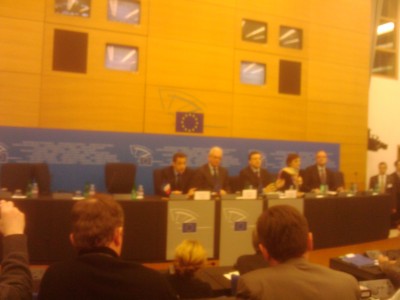
Recent developments proved that Europe can suceed to overcome challenges by aiming at great objectives, and this is needed also in 2009, said EU chairman, French President Nicolas Sarkozy.
- "It's in the name of Great Ideas, Projects, Ambition and Ideals, that EU can overcome" challenges, stressed Sarkozy at EU Parliament in Strasbourg, in conclusion of a dense 7 months EU Chairmanship. "It's even easier for Europe to have Great projects, able to overcome national egoism, instead of limiting itself only to small projects" (unable to do alike), he observed.
- "Europe must remain Ambitious and understand that the World needs her to take Decisions". "The World needs a Strong Europe", which "thinks on its own, has convictions, its own responses, its imagination" : "A Europe which does not limit itself into following" others, (as it did in the Past, when it followed USA, f.ex. on Bosnia). On the contrary, "Europe should undertake its own responsibilities", he said, after a series of succes in stopping the War between Russia and Georgia, and organizing the 1st EuroZone's Summit in Paris, which incited the Washington DC G-20 Summit to extend similar decisions World-wide.
- "When you sweep it all under the carpet, prepare yourself for hard tomorrows", he warned. "What hinders decisions is the lack of Courage and Will, the fading away of Ideals", he stressed before EU Parliament's 2008 debate on Human Rights and Sakharov prize on Freedom of thought attributed by MEPs to Chinese cyber-dissident Hu Jia, followed by an EU - Turkey meeting on Friday.
- "I don't abandon my convictions" and "I will take initiatives" on EU level also in 2009, Sarkozy announced later. "France will not stop having convictions and taking initiatives" on Europe. + "It's an Error to wish to pass over the Heads of those who are elected in their Countries" : "It's an integrism I always fought against"', he warned.
---------------------
French EU Presidency faced 4 unexpected Crisis :
- An institutional crisis, with the Irish "No" to EU Lisbon Treaty, just before it started. A geopolitical crisis, wth the threat of War between Russia and Georgia risking to throw Europe back to Cold-war divisions, on August. A World-wide Financial and Economic crisis, arriving at a bad moment before crucial 2009 EU elections. And even a Strasbourg's mini-crisis, with EU Parliament's roof curiously falling down, from unknown reasons, in a brand new building on August, provoking an unprecedented transfert of the 2 September Plenary Sessions...
But it wasn't enough to stop Sarkozy ! On the contrary, it stimulated him...
---------------------------------------
- "The better way to deal with the recent problems of EU institutions (as the "3 NO" by France, the Netherlands and Ireland) is to take them as a "Test" in order to find solutions closer to Citizens' concerns", said later in Strasbourg Sarkozy's new choice as Ministe for EU affairs, Bruno Le Maire.
- On the Institutional front, Sarkozy gave Time to the Irish to think about it, and stroke on December a deal including a New Referendum after the June 2009 EU Elections, in exchange of a promise to keep the rule of "one EU Commissioner for each EU Member Country", and some opt-outs on Defence and Fiscal EU policies, Abortion, etc. If the Irish get a "Yes" Majority, then the institutional package could be completed in 2010 or 2011 on the occasion of Croatia's probable EU accession.
He was accused in Strasbourg to upgrade EU Council and downgrade EU Commision, but he replied that "strong Political initiatives by EU Council reinforce also the more technical role of EU Commission, under the political-technical leadership of its President", all 3 "working together with EU Parliament".
- But, meanwhile, Sarkozy energetically spearheaded an Historic 1st Summit of EuroZone's 15 Heads of State and Government at EU's core, exceptionally enlarged to a partial participation of British Prime Minister Gordon Brown, on October 12 in Paris' Elysee palace, which started to tackle succesfully the growing world Financial crisis.
It also paved the way for its endorsement by a subsequent Brussels' 27 EU Member States' gathering, before it all come to Washington's G-20 Summit. And "Europe was united, it asked for the 1st G-20 Summit, and it will also organise the next G-20 Summit on April in London", he observed.
But a Conference with EU, Russia, African and other Developing Countries, hosted in Strasbourg shortly after Washington G-20 Summit by the French EU Presidency, took a Resolution asking to enlarge participation to Global Economic Governance. Many found, indeed, illogic and unacceptable that f.ex. states as Turkey were given a seat at G-20 level, while all African Countries, and even the African Union itself, representing the greatest Continent on Earth, were excluded...
Meanwhile, even USA''s "Paulson No 3" Plan, was, in fact, inspired by Europe's No 1 Plan", Sarkozy observed, largelly applauded by MEPs.
And "Europe showed Solidarity" by mobilizing some 22 Billion credit for Hungary, 1,7 billion for Ukraine, as we do nowadays for Baltic States, etc., he added.
The move on Economy was extended on December by an EU stimulus' plan totalling some 200 billion Euros, including 5 Billions released by EU Commission for big Projects, as well as various parallel National plans for Economic revival, (fex. 26 billions in France alone). They might appear limited, compared to USA President-elect Obama's reported plan to boost the American economy with 800 billion $, but at least succeded to overcome Europe's divisions for the first time on Economic governance, opening new horizons.
- The French President stressed even harder the unique role of an active EU Council's chairmanship, when he moved swiftly and efficiently, at the beginning of August, to succesfully stop War between Russia and Georgia, at the last minute, which threatened to bring Europe back to Cold War division.
"We (EU) also wanted to avoid a situation like in Bosnia, in the Past, when EU was absent, so that our American friends took their responsibilitues, and EU only followed", despite the fact that the conflict took place in Europe. Now, it was the EU who took its responsibilities".
A roadmap towards a new PanEuropean Security policy, before which all unilateral moves to place new Missiles (from USA or Russia) would be freezed, was proposed by Sarkozy after a meeting with Russian president Medvedev, at the eve of Washington DC's G-20 Summit.
Ukraine's "European" character was stressed at a Sarkozy - Jushenko Summit, September in Paris, while EU adopted on December an "Eastern policy", in which, "I'm convinced that our (EU's) future is to find with our Neighbours the conditions for Economic Development. Peace and Security, by explaining them that.. they must respect (Human Rights') Values, and adopt behaviors different from the Past", explained Sarkozy in Strasbourg.
Meanwhile, the "Union for the Mediterranean" was created, since July's Summit if 45 Heads of State and Government in Paris, as "an organisation for a permanent Dialogue, that we need", mainly in order to tackle the Israeli-Palestinian conflict, by bringing together, for the 1st time, Israelis and Arabs, where "Europe must be present, in order to avoid a frontal clash".
- "If Europe doesn't take its part for Peace in the Middle-East, nobody else will do that in our place", Sarkozy stressed.
-----------------------
Meanwhile, other EU Agreements were brokered during the French EU Presidency on Immigration, (fex. common Asylum rules, etc), and Climat- Energy :
- On Climat-Energy, the 2007 German EU Presidency had fixed a triple 20% aim for 2020 (20% renewable Energies, 20% reduction of CO2 emmission, 20% energy efficience/economies), and the 2008 French EU Presidecny realized that, making the necessary compromises in order to modernize EU's industry, but without throwing some former Central-Eastern European Countries into abrupt Economic break down risking "social explosion".
- Defence-Security EU policy was mainly postponed for April 2009, since both German chancellor Merkel and French president Sarkozy want to strike a deal with the new American president Obama in Strasbourg's NATO Summit.
However, with all these 4 unexpected Crisis diverting attention to other urgencies, People wil wonder now, what happened to the famous deal proposed by freshly-elected French President Sarkozy on Turkey's controversial EU bid, back on August 2007, to continue EU - Turkey negotiations, but on the double condition that core chapters, intrinsequally linked with EU Membership, will be excluded, and that a collective Reflexion and Debate on Europe's future would start before the end of 2008.
It was meant to reply to the crucial question : What kind of Europe do we want in 10 or 20 Years from now : A large Market, or a Political Europe, with a popular identity ? In Sarkozy's thinking, presented in his 2 landmark speeches on Europe in Strasbourg, shortly before and after the 2007 Elections, (on February and July 2007), Turkey's controversial EU bid would be incompatible with the second choice.
It's true that EU Commision's Chairman, Jose Barroso, (who had notoriously declared, as former Portuguese Prime Minister, that he found "nonsense" the idea that Europe might become equal to the US), had repeatedly tried to avoid that Sarkozy's criticism on Turkey might start winning a larger audience in Europe, preferring a discrete "wismens' committee" work. And that most of the personalities later chosen in order to participate in a Committee on Europe's Future, are too much linked with Socialist parties and/or American policies, to be really critical of USA's notorious wish to impose Turkey to the EU, as Sarkozy had noted himself since March 2007..
- "It's on EU Council's presidency to take political initiatives. EU Commission has other competences", stressed Sarkozy. The "European Ideal" is to "build Europe with the States, not against them". "Ask Europeans to chose between their countries and Europe won't work. You don't choose between your two parents : We must add them together".
"France and Germany have an Historic Duty to work together, precisely because of what happened to the Past. We have to work hand by hand. We cannot be separated.It goes beyond me and Mrs Merkel today, Mr Schroeder and Mr. Chirac yesterday. It's not a choice, it's a duty to Europe and to the World". "We need Germany, as Germany needs Europe". Compromise is inevitable, here as everywhere, and each one made some steps towards eachother's positions.
But "it's true that Mrs Merkel didn't chose her Socialist partners, while I chose mine", Sarkozy said, in an indirect hint that the Socialist Minister of Finance in Germany might be a cause of minor past disagreements in Economy, which were overcome in recent negotiations.
"We (France and Germany) have particular duties in Europe", but "in a Europe of 27 Member States, it's not enough for France and Germany to agree between them.
"I always thought that Great Britain has a special role to play in Europe. ... Now, everybody "saw what it cost payed the UK for having been too exclusively open towards the US (and) Financial services. Europe needs the UK, but also the UK needs Europe" :- "We were able to face the hardest moment of the Financial crisis because the UK clearly chose Europe", stressed Sarkozy, reminding Gordon Brown's exceptional participation to the Historic 1st Heads of State/Government Summit of EuroZone, October 12 in Paris (See EuroFora's Reportage from Elysee Palace then).
- "Some look at Europe with old glasses aged 30 years ago. While we must look at her in relation to what it will be in 30 years" in the Future, Sarkozy concluded.
Main Menu
Home Press Deontology/Ethics 2009 Innovation Year EU endorses EuroFora's idea Multi-Lingual FORUM Subscribers/Donors FAQs Advanced search EuroFora supports Seabird newsitems In Brief European Headquarters' MAPs CoE Journalists Protection Platform
BRIEF NEWS
- 00:00 - 02.06.2021
- 00:00 - 18.10.2020
- 00:00 - 19.06.2020
- 00:00 - 18.05.2020
- 00:00 - 20.04.2020
- 00:00 - 02.02.2020
- 00:00 - 09.12.2019
- 00:00 - 27.11.2019
- 00:00 - 16.11.2019
Popular
- Yes, we could have prevented Ferguson riots says World Democracy Forum's Young American NGO to ERFRA
- Spanish People Elect CenterRIGHT Majority with 1st Party and Total of 178 MPs (6 More than the Left)
- Pflimlin's vision
- The European Athletic "Dream Team", after Barcelona 2010 Sport Championship Results
- Source Conseil d'Europe à ERFRA: Debatre Liberté d'Opposants à Loi livrant Mariage+Enfants à Homos ?
- Head of BioEthics InterGroup, MEP Peter Liese : "Embryonic stem cell research reaching its END" !?
- Spain: Jailed Turkish Terror suspect with Explosive,Drones,Chechen accomplices stirs Merah+ Burgas ?
- UN Head Ban Ki Moon at CoE World Democracy Forum : - "Listen to the People !"
Latest News
- Test Photos (f.ex.+ Invit to EU + Korea Peace meeting)
- EUOmbudsmen Conference 2022: Digital Gaps affect People's Trust threaten EF Project on EU Future ?
- French Election : Black Out on Virus, but Obligation for Fake 'Vaccines" Challenged
- Both French Presidential Candidates point at "Humanism" in crucial times...
- France : Zemmour = Outsider may become Game Changer in Presidential + Parliamentary Elections 2022
Statistics
Посетителей: 67809289Archive
Login Form
Syndicate


Other Menu
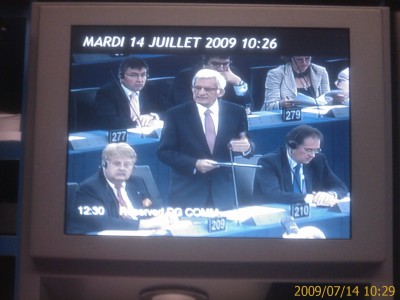
Scientific innovation joined to Faith for Human Rights, Eastern Partnership and fight against the Crisis, but above all, the need to overcome the "Crisis of Trust" from EU Citizens, are the main priorities for new EU Parliament's President, Polish Jerzy Buzek, that a 555-votes-strong majority of MEPs on July 14, Strasbourg made a living symbol of the fact that, 20 years after the fall of Berlin Wall (1989 - 2009) there is no more an Eastern or Western Europe, but only one Europe, as the head of the largest group of MEPs, ChristianDemocrats/EPP, Joseph Daul, stressed after the event.
Speaking later to a group of Strasbourg's Journalists, including "EuroFora", the new EU Parliament's President clarified his stance on concrete topical issues, as f.ex. that of Turkey's controversial EU bid, which was one of the main issues of the June 2009 Electoral campain, clearly won by his party of ChristianDemocrats/EPP : - "At present, Turkey does not fullfil none of EU conditions", he stressed, (See infra).
Buzek is well known in Strasbourg and to "EuroFora" as EU Rapporteur for the Framework Program of Scientific Research and Development of Technologies. A Natural Science Professor from the Historic and Religious landmark Polish City of Częstochowa, active in the famous Solidarnosk grass-roots social movement, he served 4 years as Prime Minister (1997-2001), before being elected as MEP in 2004 and 2009, after he brillantly won the latest EU Election at the head of his party (EPP) almost doubling the number of its MEPs from 15 to 28 !
- "Innovation" and "Energy safety", as well as fight against the "Cimat change", but also "Eastern Partnership", the "Mediterranean", "Strategic partnerships" with Russia, the USA, etc, and the search for "solutions to the Economic Crisis" that EU Citizens "expect" from us, will be his "priorities", announced from the outset the new EU Parliament's President, reminding also that the quest for "Human and Civic Rights" played an important role in his experience with the Solidarnosc grass-roots social movement in Poland's History
But, the most important of all, is the urgent need to overcome the "Crisis of Trust" between EU Institutions and the People he stressed : - EU "Citizens often don't understand us", denounced Buzek, launcing a call to "do anything for EU Citizens to understand our work" in EU Parliament : "We (MEPs) need to make EU Citizens involved" in "what we are doing every week, in Strasbourg and Brussels", he proposed. Pointing f.ex. to the hot "Debates" with "strong arguments" exchanged between MEPs during the preparation of their Legislative Decisions, in Committees, delivering often hard struggles between initially opposed points of view, long before forging a majority at the final vote, sometimes more than a year..
Therefore, EU Parliament will be "open to your criticism, for discussion and exchange of views", he promissed to Journalists in Strasbourg.
In this way, Buzek, in fact, highlighted "EuroFora"s main idea, that we strongly advocate since 1997-2007, to systematicaly and actively involve EU Citizens in public debates during the decision-making process of important EU measures, which affect their lives and the society in which they live, (and not only just a few weeks each 4 or 5 Years at the eve of EU Elections)...
--------------------
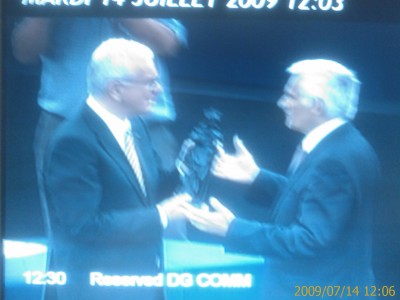
This is related also to the symbolic gift that Buzek chose to give to the out-going former EU Parliament's President, Hans Gert Poettering, (2007-2009), his collegue in the ChristianDemocrats/EPP, who brillantly won 2009 EU Elections in Germany : A genuine statute of sainte Barbara crafted in Silesia's black Coal by Polish Miners : Those simple but strong people who fought for social change against some technocrats and bureaucrats disguissed into so-called "real-socialists" of old times. (PHOTO).
It's enough to have seen a popular open air mass, at Warsaw's center, with many thousands of people, old and young, simple workers and intellectuals mixed together, with references to Poland's history and struggles for survival and liberty, through various ages, (as fex. that organized at the eve of CoE's 2005 panEuropean Heads of State and Government for the beatification of late Pope John-Paul II), in order to understand what such symbols mean..
But, overcoming the "Crisis of Trust" with EU Citizens obviously implies also to rectify any errors done in the past, fex. on Turkey's controversial EU bid, with controversial decisions taken in 1999 and 2004 to give a "candidate" status and to start EU negotiations, provoking an unprecedented series of 3 "No" to EuroReferenda and 3 Majoriy Abstentions in EU Parliament Elections : 1999, 2005 and 2009, (even if the latest one succeeded to decelerate and almost stop the drop of participation rates, opening hopes for vote's revival after an electoral campaign clearly critical to Turkey's claims in several mainstream EU countries)
Therefore, Buzek was faced with manifold critical Questions on EU Enlargement, most of them citting concrete examples of certain political problems : But his replies were almost always given as a matter of general principle :
F.ex. Questioned on the suspension of EU - Croatia talks because of a Border conflict with EU Member Slovenia, Buzek prefered to speak about principles :
- "We know that during Enlargement, the process can be blocked by failure to resolve this kind of issues", This concerns also other enlargments' cases", and "these rules are always in force" he warned.
But Buzek avoided to directly reply to a queston on "French and German EPP' calls to define the Borders of Europe", as a German journalist asked him by making a reference to French President Nicolas Sarkozy, and German Chancellor Angie Merkel's, critical statements on Turkey at the June 2009 Electoral campain.
- "Concerning Enlargement, there's always the same rules : There have to be Criteria, which have to be respected if a Country wants to join the EU", he started to simply reply.
- "For my country (Poland) it took us 15 Years to fullfil these Criteria", Buzek reminded, indicating, if proportions are kept, that Turkey, fex. would have to spend some 25 years before eventually joining the EU..
- "Countries wishing to join the EU need to Change their Systems", as we (Poland and other former Eastern European Countries) did, he stressed.
- "'For me, meeting the condition of Human Rights is one of the Key conditions for membership in the EU", preferring again to speak from the point of view of General Principles, on the occasion of an untimely question on Serbia (which is not even a candidate yet)...
- "Turkey" has, "first of all", to fullfil (EU) Copenhagen criteria". Bevause, currently, none of them is fullfiled by Turkey", New EU Parliament's President, denounced, speaking later to a group of Journalists, including "EuroFora".
In particular, on Human Rights : - "We (EU) can never forget Human Rights", because "this is at the very Foundations of the EU", Buzek added.
On the contrary, when he referred to EU Enlargment for the "Western Balkans Countries ", Buzek appeared upbeat, finding "promising situations", despite "difficulties" in the Past, since "Countries are queuing to become EU members", and this "generated changes", as he said.
As for Russia, Buzek observed that it was a "very important" country, located "in the same Continent", Europe, "close to our borders", and "we need eachother". "But Russia' has 'differend poblems : "They claim that their system is Democratic, but rules are differend", and we must be "aware of such differencies", fex. "on Human Rights", that we can't ignore, as he said;
Concerning China, where a journalist observed that the recipient of EU Parliament's latest "Sakharov prize" for freedom of thought is "still in prison", Buzek found that since the 1999 events in Tien Amin square, "we see differencies on Human Rights still today", and expressed his "support" for those who try to ameliorate the situation.
On the contrary, speaking recently to "EuroFora" he strongly supported the idea for an EU - Ukraine cooperation, fex. between Airbus and Antonov, in order to build a less costly but more performant than the old and problematic A400M, new Military Transport Airplane : - "They (Ukranian Antonov Company) can certainly do it. I'm sure they can. It's a good Idea, and I'd be glad if it was done", he told us. (See : http://www.eurofora.net/newsflashes/news/airbusantonov.html )