


PanEuropa/Germany President F.MEP Posselt: "ALL FOR LIFE" ? (in Virus Times)


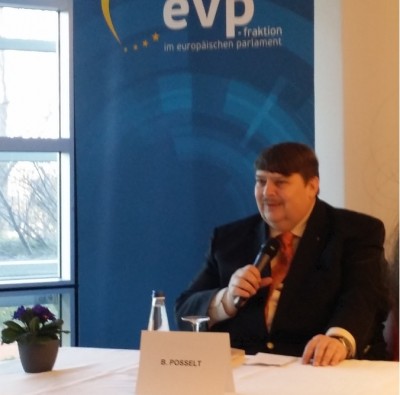
[NDLR: The President of PanEuropa/Germany, Experienced former Long-Time MEP, Journalist and Author, Bernd Posselt, send to "Eurofora" a Topical and Important Article on Human LIFE's Value Nowadays, during the CoronaVirus' Pandemic. When Tragic and/or Scandalous Events obviously Threaten to Degrade the Value of Human Life almost every day, such Moves are as a Lightning in the Dark...(ACM)
After the Original in German Language, Follows a Translation in English]
-----------------------------
"Alles für das Leben?
GRUNDRECHTE: Klare Konsequenzen
von Bernd Posselt
Seit dem Ende totalitärer Regime wie Faschismus, Nationalsozialismus und Kommunismus wurden in Europa nicht ein einziges Mal die elementaren Grund- und Menschenrechte so sehr angetastet oder gar suspendiert wie derzeit. Wenn auch sachlich gerechtfertigt und im Rahmen demokratischer Rechtsstaatlichkeit limitiert, ist dieses Vorgehen unserer Regierungen ein beispiellos schwerer Eingriff in nahezu alles, was uns bislang heilig war: Freiheit, Religion, Eigentum, Familie und soziales Gefüge. Die einzige Legitimation dafür ist ein Recht, das allen anderen übergeordnet ist und auf dem alle anderen aufbauen, nämlich das Recht auf Leben und körperliche Unversehrtheit. Um dieses zu gewährleisten, sind unsere Staaten entstanden, unsere völkerrechtlich abgesicherten Rechts- und Friedensordnungen sowie die Europäische Union.
Wie kann es dann aber sein, daß wir ein so elementares naturrechtliches Prinzip seit Jahrzehnten zum Teil der Wegwerfgesellschaft gemacht haben? Ein typischer Materialistenspruch lautet, daß jeder Mensch ersetzbar sei. Das Gegenteil gilt! Jeder ist ein Ebenbild Gottes und von daher unersetzlich. Daraus zieht die katholische Soziallehre klare Konsequenzen, wenn sie sagt, daß die Wirtschaft für den Menschen da ist und nicht der Mensch für die Wirtschaft. Dasselbe gilt für den Staat: Er hat dem Menschen zu dienen und nicht umgekehrt. Beides ist vielfach in Vergessenheit geraten. Menschliches Leben, an sich unantastbar von der Zeugung bis zum natürlichen Tod, wurde immer mehr zur Disposition gestellt, vor allem, wenn es sich um ungeborene Kinder, um Alte, um Schwache oder um Behinderte gehandelt hat.
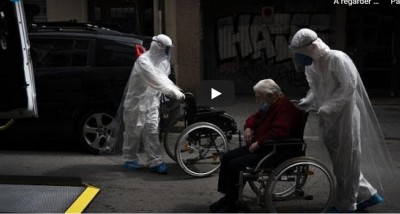
Derzeit spüren wir wieder ganz deutlich, wie kostbar das Leben ist - das unserer Lieben, unserer Umgebung und auch das eigene. Vielleicht gelingt es uns aber auch, das wieder zu entdecken, was Papst Johannes Paul II. und Mutter Teresa, die in den Slums von Kalkutta persönlich den dort grassierenden Seuchen entgegentrat, als "Kultur des Lebens" bezeichneten.
-------------------------------------------------
Comments, 21. April 2020
All (Everything) for Life?
Fundamental rights: clear consequences
by Bernd Posselt
------------------
Since the end of totalitarian regimes such as Fascism, National Socialism and Communism, fundamental Human Rights in Europe have not been affected or even suspended as much as they are at present. Even if justified objectively and limited within the framework of democratic rule of law, this action by our Governments is an unprecedented heavy intervention in almost everything that has been sacred to us so far: freedom, religion, property, family and social fabric.
The only legitimacy for this is a right which is superior to all others and on which everyone else builds, namely the right to Life and physical integrity. In order to ensure this, our States, our international legal and peace regulations and the European Union have been created.
How, then, can it be that we have made such an elementary principle of natural law, part of the discarded Society (of Disposal) for decades? A typical materialist is saying that every human being is replaceable.
The opposite is true! Everyone is an example of God and therefore irreplaceable. The Catholic social doctrine draws clear conclusions from this when it says that the economy is there for the people and not the man for the economy. The same applies to the state: it has to serve the people and not vice versa.
Both have often been forgotten. Human life, in itself untouchable from conception to natural death, has become increasingly available, especially when it comes to unborn children, the elderly, the weak or the disabled...
At this moment, we feel again very clearly how precious life is- that of our loved ones, our surroundings and also our own. But perhaps we will also rediscover what Pope John Paul II in the past, and Mother Teresa, who personally faced in the slums of Calcutta the Diseases that were raging there, have called "Culture of Life".
------------------
NDLR : Fast Translation in English, from the Original in German, Published, earlier Today, also at "Dolomiten" Newspaper, of South Tyrol, (NE Italy, near Austria).
Main Menu
Home Press Deontology/Ethics 2009 Innovation Year EU endorses EuroFora's idea Multi-Lingual FORUM Subscribers/Donors FAQs Advanced search EuroFora supports Seabird newsitems In Brief European Headquarters' MAPs CoE Journalists Protection Platform
BRIEF NEWS
- 00:00 - 02.06.2021
- 00:00 - 18.10.2020
- 00:00 - 19.06.2020
- 00:00 - 18.05.2020
- 00:00 - 20.04.2020
- 00:00 - 02.02.2020
- 00:00 - 09.12.2019
- 00:00 - 27.11.2019
- 00:00 - 16.11.2019
Popular
- Yes, we could have prevented Ferguson riots says World Democracy Forum's Young American NGO to ERFRA
- Spanish People Elect CenterRIGHT Majority with 1st Party and Total of 178 MPs (6 More than the Left)
- Pflimlin's vision
- The European Athletic "Dream Team", after Barcelona 2010 Sport Championship Results
- Source Conseil d'Europe à ERFRA: Debatre Liberté d'Opposants à Loi livrant Mariage+Enfants à Homos ?
- Head of BioEthics InterGroup, MEP Peter Liese : "Embryonic stem cell research reaching its END" !?
- Spain: Jailed Turkish Terror suspect with Explosive,Drones,Chechen accomplices stirs Merah+ Burgas ?
- UN Head Ban Ki Moon at CoE World Democracy Forum : - "Listen to the People !"
Latest News
- Test Photos (f.ex.+ Invit to EU + Korea Peace meeting)
- EUOmbudsmen Conference 2022: Digital Gaps affect People's Trust threaten EF Project on EU Future ?
- French Election : Black Out on Virus, but Obligation for Fake 'Vaccines" Challenged
- Both French Presidential Candidates point at "Humanism" in crucial times...
- France : Zemmour = Outsider may become Game Changer in Presidential + Parliamentary Elections 2022
Statistics
Visitors: 67558925Archive
Login Form
Syndicate


Other Menu
Sarkozy and Merkel want deals with Obama on European Security at Strasbourg's NATO 2009 Summit
------------------
In parallel but concording moves, EU Chair, French President Nicolas Sarkozy and German Chancellor Angie Merkel both invited this week US-President elect, Barack Obama, to discuss important deals breaking new ground on European Security during the NATO's 60 Years Anniversary Summit of Heads of State in Strasbourg, where Obama is expected to make his 1st visit to Europe as a President on April 2009.
Merkel focused mainly on smoother NATO - EU Defence and Security policy cooperation, while Sarkozy spoke about PanEuropean Security, associating both Russia and the USA, proposing to freeze missile and shields' deployement until an agreement is reached.
But both tackled some hard nuts to crack : Turkey's VETO against the participation of EU Member Cyprus to EU-NATO cooperation, and Russia's anouncement on deployment of missiles up to Kaliningrad, at EU's belly, in reply to USA's wish to set up missile shields in EU States such as Poland or Czech Republic, etc.
---------------------
- "Certainly...one of the points that we'll dicuss with the New US President", Barak OBAMA, "who will come f'or the 1st time in Europe as president, at the NATO Summit", co-hosted by France and Germany in Strasbourg, ""concerns, above all, the European Security and Defence Policy" (ESDP), and "the relations between NATO and its partners", with whom it should "work together", anounced earlier this week Merkel.
We must find "a reasonable and adequate concept to articulate NATO and European Security and Defense policy", because of a "series of practical issues, sometimes difficult to understand", but that "we must discuss".
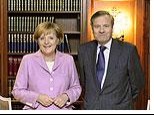
- "An example" of that is "the issue of Cyprus and Turkey", said Merkel, where Ankara raises problems "from Kosovo up to Afghanistan", as also CoE's chair, Swedish Foreign Minister Carl Bildt recently observed in Strasbourg replying to EuroFora's questions.
- "We must do something to smoothen this problem for good, and not only on a case-by-case basis, laboriously negotiated each time". Here, we must find "a reasonable and adequate concept to articulate NATO and European Security and Defense policy", Merkel stressed.
- "With good will from all sides, it could and should be posible. Germany wants also to help on that". Otherwise, "the coming generations will not understand why it took Decades to do so". But, if we "don't even achieve that for Decades, this would be an Historic Failure !", the German Chancellor warned
- "I think that our American partners are increasingly realizing that", Merkel said, pleading for "a stronger European Security and Defence policy, with which, I believe, the Atlantic Security Partnership can also strengthen and solidify".
Meanwhile, USA is also due to take in 2009 a special status inside EU-led EUROCORPS, the European Army HeadQuarters, based in Strasbourg.
Merkel said that after meeting in Berlin with NATO's Secretary General, Jaap de Hoop Scheffer, earlier this week, precisely in order to "prepare NATO's Summit", scheduled for the beginning of April 2009 in Strasbourg.
Scheffe, knows well Strasbourg, since he chaired the CoE, as Holland's Foreign Minister, when he brokered a controversial deal precisely on Turkey and Cyprus about the implementation of ECHR judgements on Greek Cypriot displaced persons' houses and properties in 2003. He returned later at least once, for a WEO meeting at the CoE, where he precisely had highlighted such EU - NATO issues.
EU Commission's 2008 Report on Turkey has just observed that, on European Defense - Security policy, "Turkey continues to object to EU-NATO Cooperation which would involve all EU Member States". "This created Problems for EU-NATO co-operation in the context of Civilian ESDP missions, in particular in Kosovo and Afghanistan".
----
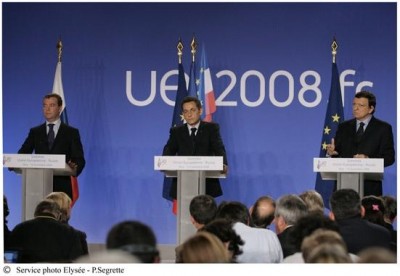
French EU Chair, President Sarkozy and Merkel are visiting Washington on Friday and Saturday for a Global G-20 Summit with current US President George Bush, on the sidelines of which are expected preparatory contacts with US President-elect Obama's entourage, even if himself might stay in Chicago until he takes over on January 21.
Before going to Washington, Sarkozy concluded today an UE - Russia Summit with Dmitry Medvedev, where they "spoke in length on PanEuropean Security" :
- As EU President, I proposed that we meet on mid-2009 in a framework such as OSCE's in order to set the foundations of a Future Pan-European Security, which would associate Russia and USA, and that, meanwhile, nobody speaks about deploying missiles or shields, which complicate the situation".
- NATO's Summit in Strasbourg-Kehl, on April 2009 is a perfect occasion to discuss with our American friends and to prepare a possible OSCE Summit for these issues f.ex. for June or July", Sarkozy concluded.
- We must all abstain from Unilateral measures" dangerous for Europe's security. "Russia only reacted to decisions taken by some other countries. But if they are ready to cooperate, we are ready to discuss. EU could be an intermediary", added Russian President Dmitry Medvedev, before going himself too at the Washington G-20 Economic Summit.