


 newsitems EU Parliament Regional Committe Chair Hubner to EuroFora: How to use 82 Billions € Structural Funds
EU Parliament Regional Committe Chair Hubner to EuroFora: How to use 82 Billions € Structural Funds


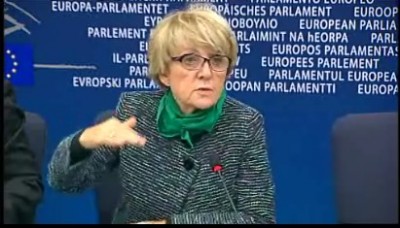
*Strasbourg/EU Parliament/Angelo Marcopolo/- For the 1st time since the Jan. 2012 EU Summit decided in Brussels to free some 82 Billions € from unspend yet Structural Funds for SMEs and Jobs particularly to Young People, the Experienced former EU Commissioner and now New EU Parliament's Committee President for Regional Development, Professor Danuta Hübner, a ChristianDemocrat/EPP MEP and former MInister, replying to an "EuroFora"s Question, explained how to use these special EU Funds, by "Re-Programming" available Structural Funds, while also raising the "Co-Financing Rates", but also avoiding risks of "Capture" by Finance Ministers eager to pay first the Debts, as she warned, among a long series of various, useful advise on how to use them in a way which might really succeed their absorption for SME Growh and Young a.o. People's Employment, mainly in the 6 more needy EU Countries :
- "About the 82 Billions € : Initially, a similar idea, at a smaller scale, had been first evoked for Greece, (in order to fight against recession) about some EU Structural Funds which hadn't been used", "EuroFora" reminded in one of our Questions to President Hübner's Press Conference in EU Parliament in Strasbourg, (See other "EuroFora" NewStory, herewith, on other from our Questions to -and Replies from Danuta Hübner, on differend issues).
- "But now (on 2012) it's for much more (EU) Countries (8)". However, "it was already said both before, and now, as you know very well, that one of he Problems was how to find funds needed for Co-financing : Something particularly Difficult in times of (Global) Crisis", we reminded.
=> "Certain Measures were scheduled for that purpose. Do you think that they are sufficient ? How this supplementary Co-financing could really work in practice ?", "EuroFora" asked Hübner.
+ As for "the Freedom for Re-Programming, (that she had cited from the outset), do you think that it should be total, i.e. as a "Tabula Rasa", completely New and fresh, or should it stay closer to the initialy Scheduled Programs ?", we wondered.
-------------------------
- "On the Co-Financing, because it has become during the (Global) Crisis an extremely Important issue", as she admitted, "there were Suspicions that it might be a factor for Slowing down the Absorption, and, in cases of Countries like Greece, but not only, there was a Clear Evidence that the Lack of Co-Financing is a Major Factor", the experienced former EU Commissioner agreed, indeed, with "EuroFora"'s critical observation.
=> - "That's why, what I was eluding to (in her preliminary remarks), was the Proposal that EU Commission adopted on August, which came on September (2011) to the Parliament, and we voted in the Plenary at the beginning of December, on Increasing the Co-Financing Rates, in terms of the Part which is coming from the EU Budget :
- "So, this Amendment which allowed for a Top Up of a 10% point on the Co-Financing Rate, which is Differend in Convergence Countries, differend in Ireland where you had the Maximum in 50%, in convegence countries you had 85% in Co-Financing rates. So, 10% points above this Maximum", Hübner reminded.
- "I was Rapporteur for this Amendment, we (EU Parliament) did it very quickly, and, as a result, f.ex. Greece, from the Data that I know, received in December (2011), before the End of the Year, additional more than 700 Millions €, thanks to this increase of Co-Financing Rates".
- "It does not increase the allocation of the funding, or the EU Budget, because it's within the allocation. But you can have a bigger share of EU funding for the Project that you implement", she explained.
=> "Theoretically, that's what we are hoping, that should have Facilitated the use of EU Funding and going on with the Projects", stressed the President of EU Parliament's Committee for Regional Development.
>>> (But), "my Suspicion is, however -and I hope I'm totally wrong- that this Money, f.ex., in the Countries that have to reduce Deficits and pay Debts, there is a Risk that this Money has been "Captured" by the Ministries of Finances, in order to reduce he Debt, even if it's only by 700 Millions €, but that could be a tranche, maybe for a Month or so, or a part of a tranche", Hübner warnedé...
- "On this, we (MEPs) hope to get also the Information from the EU Commission soon, on how the Money that was allocated or shifted, forclosed to the 6 Countries that got the Right for this Increase of Co-Financing, (i.e.) whether this Money was realy used in order to accelerate EU Projects that generate Jobs and Growth. In this sense, I Think, we could help. But whether this is the case (or not), we (EU Parliament), don't know yet, at this stage", she observed carefully.
- "Obviously, in the (particular) case of Greece , Co-Financing could not come from National Budgets, nor the private Commercial Banks which could provide Credits to Beneficiaries. Because the Financial, Banking sector doesn't function (currently) in Greece (mainly since Debts are to be paid in priority), so, the Private Investors, even if they might have Cash, it would be too Risky for them to Co-Finance the Projects. That's why this (particular) increase of Co-Financing Rates was so importantr (in the case of Greece)".
+ "So, now, what I'm saying for these Risk-Sharing Facilities, in order to overcome this problem, of the Lack of Private participation in Big Projects, which generate Revenues, and that means that they are usually linked with the participation of the Private Sector.
- "This has been addressed as an issue for the 6 Countries for which it was decided by the (EU) Council that we should take on board the Change of Co-Financing, for 6 Countries which are particularly Distressed. These are the Countries that usually benefit from 1 of the 2 Tools of Financial Assistance : On Balance of Payments or the Stability EFSM", she explained.
a
------------------------------------------
+ On the second point raised by "EuroFora"s 1st Question, Hubner replied that", Now, I think, "Re-Programming", this is envisaged in the Regulations that there are Reviews of the Programs, because 7 Years it's a lot of Time, and with the Speed of Change, escpecially in Growing Economies, but also with the Global Competition, these Policies are often "open" towards Re-Programming"
- "But it's rarelly, as You say , really "Tabula Rasa". It's rarely shifting towards Completely Differend Objectives : Usually Changes are Proportional or Expanding the possibility of Investing also in Other Areas"; she expained.
- "F.ex. in this perspective, the (EU) Commission had demanded from the Member States that, in the Re-Programming at the Middle of the Financial Perspectives, the "Energy Efficiency" is taken more seriously on board, and, now, a Further Re-Programming (in order) to shift towards Youth and UnEmployment, with furher Job support and SMEs", President Hübner said.
+ "But, in the Current period, we have more than 55 Billions € for the support for Enterprises, and, most of it, is for Small and Medium sized Companies. So, it's again, "Nothing New", but, again, a Stimulus to pay more Attention to SMEs, in producing Employment especially", she concluded.
-----------------------------------------------------------
***
(NDLR : "DraftNews", as already sent earlier to "EuroFora"s Subrscribers/Donors. A more accurate and complete Final Version is due asap).
***
Main Menu
Home Press Deontology/Ethics 2009 Innovation Year EU endorses EuroFora's idea Multi-Lingual FORUM Subscribers/Donors FAQs Advanced search EuroFora supports Seabird newsitems In Brief European Headquarters' MAPs CoE Journalists Protection Platform
BRIEF NEWS
- 00:00 - 02.06.2021
- 00:00 - 18.10.2020
- 00:00 - 19.06.2020
- 00:00 - 18.05.2020
- 00:00 - 20.04.2020
- 00:00 - 02.02.2020
- 00:00 - 09.12.2019
- 00:00 - 27.11.2019
- 00:00 - 16.11.2019
Popular
- Yes, we could have prevented Ferguson riots says World Democracy Forum's Young American NGO to ERFRA
- Spanish People Elect CenterRIGHT Majority with 1st Party and Total of 178 MPs (6 More than the Left)
- Pflimlin's vision
- The European Athletic "Dream Team", after Barcelona 2010 Sport Championship Results
- Source Conseil d'Europe à ERFRA: Debatre Liberté d'Opposants à Loi livrant Mariage+Enfants à Homos ?
- Head of BioEthics InterGroup, MEP Peter Liese : "Embryonic stem cell research reaching its END" !?
- Spain: Jailed Turkish Terror suspect with Explosive,Drones,Chechen accomplices stirs Merah+ Burgas ?
- UN Head Ban Ki Moon at CoE World Democracy Forum : - "Listen to the People !"
Latest News
- Test Photos (f.ex.+ Invit to EU + Korea Peace meeting)
- EUOmbudsmen Conference 2022: Digital Gaps affect People's Trust threaten EF Project on EU Future ?
- French Election : Black Out on Virus, but Obligation for Fake 'Vaccines" Challenged
- Both French Presidential Candidates point at "Humanism" in crucial times...
- France : Zemmour = Outsider may become Game Changer in Presidential + Parliamentary Elections 2022
Statistics
Visitors: 62688662Archive
Login Form
Syndicate


Other Menu
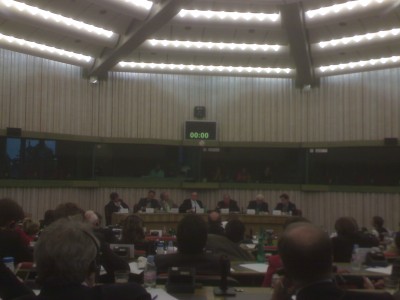
UK Prime Minister, Gordon Brownn's promise to French President Sarkozy that Great Britain will proceed to Lisbon Treaty's ratification was certainly fuelled further by MEPs' warning, meanwhile in Strasbourg, that all Enlargement stops until EU can have efficient Institutions for more than 27 member Countries.
EU Parliament's President, German MEP Hans Gert Poettering, formally announced this position, after consulting all Political Groups' Chairmen, Monday in Strasbourg, and most MEPs made the point crystal clear during Plenary Debates on Wednesday.
Thus, from Thursday, UK's House of Commons, at Westminster, gave its "Green Light" to Lisbon Treaty's ratification, which was completed later-on, after ovecoming some last minute attempts to block the process.
- In only 3 other Member Countries we feel some "hesitations" : Poland, Czech Republic and Cyprus", said, meanwhile, EU Chairman-in-office, Slovenian Foreign Minister, Dr. Dimitri Ruppel, speaking to EU Parliament's Foreign Affairs Committee in Strasbourg, However, "I didn't hear any explicit refusal", he carefully added.
Rupel's fears were later bellied in Cyprus' case, where a wide majority of political parties confirmed their support to the EU Treaty, but fears were confirmed in Poland's case, while Czechs said they waited for their Constitutional Court to pronounce itself.
A paradox is that the Polish President Lech Kaczynski, who reportedly expressed concerns about Lisbon Treaty, had personally signed himself its blueprint, while, on the contrary, Cyprus' new President, Christofias, despite its own party's opposal, declared that he'll respect the signature of his precedessor, former President Tassos Papadopoulos, in favor of EU Treaty.
But, "all that noise is a misinterpretations by some Western Media : Poland will ratify the EU Treaty, and even earlier than some other Member Countries", declared to "EuroFora", in a surprisingly optimistic tone, the Polish Chairman of EU Parliament's Foreign Affairs Committee, Jacek Saryuswolski...