


 newsitems Minister to EuroFora: EU Financial Perspectives not yet at Franco-German 50th Anniversary 1st Summit
Minister to EuroFora: EU Financial Perspectives not yet at Franco-German 50th Anniversary 1st Summit


*Asperg (Ludwigsburg area, Germany)/Angelo Marcopolo/- At a last-minute decision to hold a Press Conference after an exceptional Franco-German Summit scheduled this Saturday to mark the start of a series of events prepared to celebrate the 50th Anniversary of the Franco-German EU motor, Chancellor Merkel and President Hollande, almost confirmed, a contrario, the more vivid than ever, ambiant impression today, that, while dealing in priority with various Urgent matters, €uroArea's biggest countries will soon have to seriously start discussing and deciding on an overall Strategy, with crucial choices on Values able to attract EU Citizens' support, for Europe's Future in a Globalized World, as the topical reminder of De Gaulle's Historic 1962 speech to Thousands of Young People at the nearby Ludwigsburg Castle, when he was just launching, together with Adenauer, the Franco-German reconciliation for a strong Europe with a specific role in the World, made obvious at a public ceremony earlier today, (See relevant "EuroFora"s NewsReport).
- Already, speaking to "EuroFora" in Asperg, just before the Hollande - Merkel Press Conference starts, experienced French Minister of Economy, former EU affairs Minister and f. EU Parliament's vice-President, Jean-Pierre Moscovici, revealed that it's not certain, at least at this moment, whether EU leaders would reach an overall agreement on the most far-reaching, Strategic and concrete decision that they notoriously have to take, if possible before the end of 2012 (Comp. earlier "EuroFora"s NewsReports on that issue), i.e. that of EU's Pluri-Annual Framework for the 2014-2020 Financial Perspectives, which is objectively interlinked, in fact, with many Political Choices, and requires to shape a comprehensive Vision about Europe's Future :
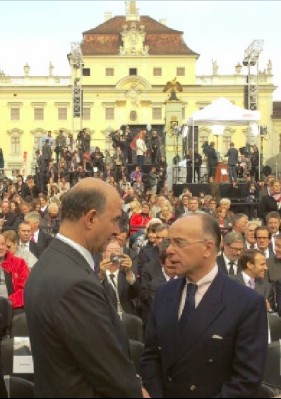
- "I really don't know", if a deal will be brokered before the end of 2012 on EU's Financial Perspectives, honestly replied Moscovici in a relevant "EuroFora"s Question, while also clearly indicating earlier that today's Franco-German Summit would be rather focused on more Urgent, particular issues, such as how to organize "the Banking Union" EU project, developments on efforts to definitively solve the problem of the Debt provoked in Greece (from where the EU/IMF/ECB "Troika" just departed, awaiting crucial final decisions), the EADS - BEA Air-Space conglomerates' project to unite the Continental and Brittish High-Tech Industries in order to create a New Giant in front of Global Competition, possible developments on Spain, etc. (comp. also infra).
However, even if such currently "pending" issues have been mainly scheduled for Decisions on October 2012, while EU will hold a special November 2012 Summit in Brussels essentially focused on the 2014-2020 Financial Perspectives, it's obviously true that, particularly today, when an important advance towards a closer Political Union in Europe is notoriously needed, in fact, no notable Decision on any important particular issue could really be taken without at least an elementary overall Vision on Europe's Future, as De Gaulle's Historic 1962 Speech reminded earlier today when it was projected at Ludwigsburg's Castle, together with Merkel and Hollande's speeches which opened this crucial 50th Anniversary of EU's Franco-German motor, (See "EuroFora"s specific NewsReport from the spot).

- This was made even more clear, indirectly but surely, f.ex. also when Chancellor Merkel started this afternoon's Press Conference by stressing from the outset that "despite all Difficulties, the Memory of French President Charles de Gaulle, and of what happened in Ludwigsburg, attest that our young People will continue to guarantee that Franco-German relations, as well as relations between all Europeans, will develop well".
+ In addition, "we dealt with what has to be solved now, discussing various currently important Current Affairs", the German Chancellor went on to say, citting, f.ex., EADS-BEA fusion projects, the preparation of October 2012 EU Brussels' Summit, developments in Spain, etc., before replying to a few Questions, together with Hollande, on some more issues.
-------------------
- "We have to recall our History, in order to realize where we come from", (in particular by "evoking -De Gaulle/Adenauer's- Audacious acts.. which made possible for the Franco-German Friendship to generate the European Union of today", before starting to fulfill our "Duty to Act, both for the Present, and in order to prepare the Future", added Hollande.
+ As for the "Short Term", "we have to deal with the issue of Greece -where Troika's work goes on- and of Spain, whose call to support its Banks received a positive reply for 100 Billions €", to check well all the "Conditions" for the EADS-BEA fusion project, while we must also "translate the Banking Union in the facts and give it a meaning", as well as "Strenghen our Governance" and "deepen our Economic and Monetary Union", thanks to a plan for the end of 2012, noted the French President.
----------------

In particular, the Franco-German political will to Deepen further €uroArea Summits' Governance, (as it was initiated by the August 16, 2011 Sarkozy-Merkel Summit at Elysee Palace in Paris, as well as EU Brussels' Summits from December 2011 up to January and March 2012 : See "EuroFora"s NewsReports from two of these three landmark events) was confirmed both by Merkel and Hollande, shortly after nearby Karlsuhe's German Constitutional Court unblocked definitively the New €uroArea Treaty earlier this Month :
- "We need Stronger Cooperation in €uroGroup on Economy', and, "therefore, we (Heads of State/Governments) shall Meet more often in order to develop further our Economic Community of all €uroCountries, and examine how we make Growth, the Measures that we must take, the main Indicators, the Causes of Economic Differences, etc., so that we can work closely together to boost and rapproach Competitiveness throughout €uroArea, in a way that helps Growth and Jobs", anounced Merkel.
+ Indeed, "France and Germany must take Initiatives in order to Coordinate our Policies, ameliorate further our Decision-making, .. and become able to Act, whenever needed, with Regularity", so that we can bring back Trust, acquire Good Decision-Making Mechanisms, settle outstanding issues (and in particular "Competitiveness and Growth"), and give to the EU a Perspective", added on this Strategic point Hollande.
- Our aim should be to solve the outstanding, current affairs until the End of 2012, so that we can start on 2013 "another Agenda", focused on "Strengthening our Union", he highlighted.
--------------------
Questioned on "Compromises" and on the Timing for the "Banking Union" aim, (perhaps the most Innovaive result of June 2012 Summit, its other aspects having, more or less, already been prepared or at least initiated by earlier EU Summits), it's true that Hollande and Merkel appeared to have a little bit different view on the Timetable's priorities :
- The German Chancellor, leaving concrete "Details" for the "Finance Ministers", prefered to focus on the "importance" it has to "study thoroughly" the matter and to "ensure" the Good "Quality" of "the Supervision of the Banks", in order to "win back Markets' Trust", instead of "doing too quickly something which might not work so well afterwards", as she warned. Therefore,she concluded that *this work must be done as soon as Possible".
- The French President agreed that the "Banking Union" must be done "Gradually", and, considering that "the ECB should be the Supervisor", "we can see how this could cover as much Banks as possible", he added, making it cleat that "France's position" is in favour of doing that "the Soonest".
----------------------------------------
+ But, the primordial need for EU Perspectives became anew obvious when Merkel and Hollande were invited to reply to a "Tricky" question by a French journalist from Paris : Merkel approaches the end of her mandate (after one Year), but she is much more Popular than Hollande, who has just started his mandate, but already fell dramatically Down in the Polls, she observed. How do you both feel about that ?, she asked...
- Merkel, (in favor of whom the last 2 Polls in Germany clearly show an exceptionally Strong Popular support, which extends, at the latest poll, from 49% up to 60%, against only 16% to 28% for her main political opponents), firmly confirmed that she will be anew Candidate for the Chancellorship also for the next 5 Years (2014-2019) at the next Elections towards the end of 2013, and, kindly relativizing Polls' ups and downs, preferred to focus on the importance of having "a Vision" for Europe, as "bold" as De Gaulle did, and stressed that, what matters most is that "both" French and German People "firmly believe that we need a Strong Europe, with its Values, to have an important Voice in the World".
- Hollande, (for whom, 2 recent Polls revealed that Popular support has too fast fallen to a Minority, which has just dropped down to only 43% against 56 %, according to the latest Polls), preferred to Postopone politically relevant appreciations only on Final "Results" visible "at the End of (his) mandate", because "what matters most are the Votes of the People, when they are Consulted", as he said, (i.e. at the latest on 2017, if it isn't interrupted or disrupted earlier, f.ex. as in the case of De Gaulle himself, back on the 1969's failed Referendum, or of President Chirac's 1997 failed Parliamentary Election which obliged to "cohabitate" with a "Socialist" Prime Minister for years, until he won a Double, Presidential and Parliamentary Election on 2002, etc). What is important is "the Target at which we aim, the Means to reach it, and the Energy we put in order to obtain Results", stressed the French President, expressing the hope to "help arrive at a better situation that what I found when I started", as he added, (perhaps underestimating a bit the Historic, Global Crisis which started at the end of 2008 in all Countries accross the World).
-------------------------

The last Question looked more "Spicy" vis a vis Hollande : - "How far have you advanced in Personal Friendship between you ? It was always said that between Sarkozy and Merkel the cooperation was Excellent. But what about Hollande and Merkel ?", a German journalist asked.
- "Thanks God, People can have many Good Relationships", smiled smartly Merkel in reply, calling her personal relation to Hollande as "Friendly", "in our joint effort to help our Countries, and also all Europe, advance towards what is Best".
- "When it comes to lead Europe", "we exchange views, as much as possible and necessary, in good faith, searching always a Compromise able to attract also the other" EU Member Countries, replied Hollande. - "It would be an Error to believe that, once we (France and Germany) agree, all the others must follow us. But another Error would also be to Disagree", because "it's very Important for France and Germany to be always able to joint eachother in the Target fixed ahead, and on the Stages which must be crossed", since "it's true that we are Bound by History" to do so, as the French President reminded.
- Even if today, we are not placed in front of a similar Challenge as the "Barbary" which had opposed our two Countries and Divided Europe in the 2nd World War, as was De Gaulle, when he spoke here only 20 years after that, nevertheless, "we are facing a Crisis, a Europe which has some Doubts about itself, a €uroArea which had given, earlier, some indications of weakness", etc., so that, "the Responsibility of those who lead Germany and France is to take the Right Decisions", he pointed out.
- In order to be able, "20 years later, when others will come anew here (at Ludwigsburg) to salute the Franco-German Friendship, to hear them say that we all acted usefully for Europe, and we were also Audacious", (as De Gaulle was), Hollande concluded,
... naturally implying that, in the mean time, he would have made a good and timely agreement with German Chancellor Merkel and all other EU Member Countries, also on "EuroFora"s query about the crucial and Strategic issue of EU's 2014-2020 Financial Perspectives, (comp. Supra)...
-------------------------------
+ Meanwhile, even if no official anouncement was ever made to explain the choice of Asperg for the Franco-German leaders' Lunch, (except, naturally, from a brief mention of the .. "Famous Quality of the Restaurant"), neither for the last-minute Change about the principle and the location of this exceptional Hollande - Merkel Press Conference, the Day they launched the 2012-2013 Celebrations for the 50th Anniversary of the Paris-Berlin EU "motor" crystallized in the "Elysee Treaty", which will be celebrated by the two Governments gathered together on January 22, 2013, in Berlin, as it was officially anounced earlier today,
nevertheless, "EuroFora" found several interesting Facts which reveal an important, pertinent and timely Symbol (as Chancellor Merkel notoriously likes to use) in the Historic Links of this Hill, which is more important than what one might think at first sight :
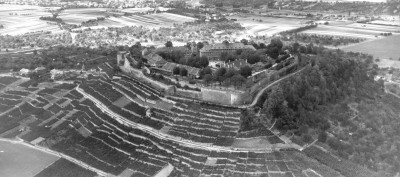
Asperg was, in Ancient Times (400-500 AC), the Historic Headquarters of Frankens' Parliament, or Free Citizens' Assembly, a reminder of Ancient Greece's Direct Democracy by Peuple's Assemblies, located in special, spacy Public areas, (as, f.ex. at Acropolis Hill's feet), and it is geographically just an extension of Ludwigsburg's region, which became, later-on, during the Enlightnement (1.700-1.800 AC) a large, open area, full of inteconnected Gardens surrounded by Forests, around the extending Castle.
----
+ Moreover, from a GeoPolitical point of view, a Long History, since the Early Stone Age, (because of an exceptionaly Fertile Soil and a Hilltop close to Rivers), made of the area a Strategic Stronghold, that was used afterwards by Romans in order to bult their main Road linking Rhine and Danube Rivers, , while some consider that its Castle was built to control communications going as far as from Flanders up to the Black Sea, but also Italy, etc.
But there is an even more important Symbol for Today's modern concerns, when EU notoriously searches to find ways to realise a strong Political Union with real Popular support, (comp. relevant, recent "EuroFora"s NewsRepors, f.ex. : .....) :

Asperg had become the Capital of Franken, after their victory over the Allamani, (i.e. at a period during which a Central European Area united together various Population Groups among those from which emerged later-on as French, German and Swiss People, etc), with a Popular Assembly established there, of a similar kind of what was used to be called then "Ding" or "Denk", "Thing" or "Think", etc., and is found in many European Countries such as Germany, France, England, Sweden, etc., i.e. a Forum open to active Participation by alll Free People, (pictured f.ex. in some Roman sculptures in Rome), strinkingly similar to Ancient Greece's "Agora" at Acropoli Hill's footstep, where "the (Free) People used to gather together, forming a (decision making) Assembly", (as experienced Greek Professor of Philosophy Gianaros had resumed at "EuroFora" during a recent Lecture at Strasbourg's University).
A timely hint also at CoE's landmark debate, between Presidents of Parliaments from 48 Countries (all over a PanEuropean space including Russia, EU Parliament, OECD Assembly, the International Inter-Parliamentary Union, etc), which focused, earlier this week in Strasbourg, among Europe's will to guarantee at least an elementary Respect for Human Rights, and the current need to deal with fast-evolving developments in Neighbouring, particularly 3rd Mediterranean Countries, mainly on the ways to overcome a current Crisis of traditional Parliamentarism, by creating better and closer, regular links to Citizens, including by innovative uses of modern Communication Technologies, etc, (comp. relevant "EuroFora"s NewsReports).
(../..)
***
(NDLR : "DraftNews", as already sent earlier to "EuroFora"s Subscribers/Donors. A mor accurate, full Final Version may be published asap).
***
Main Menu
Home Press Deontology/Ethics 2009 Innovation Year EU endorses EuroFora's idea Multi-Lingual FORUM Subscribers/Donors FAQs Advanced search EuroFora supports Seabird newsitems In Brief European Headquarters' MAPs CoE Journalists Protection Platform
BRIEF NEWS
- 00:00 - 02.06.2021
- 00:00 - 18.10.2020
- 00:00 - 19.06.2020
- 00:00 - 18.05.2020
- 00:00 - 20.04.2020
- 00:00 - 02.02.2020
- 00:00 - 09.12.2019
- 00:00 - 27.11.2019
- 00:00 - 16.11.2019
Popular
- Yes, we could have prevented Ferguson riots says World Democracy Forum's Young American NGO to ERFRA
- Spanish People Elect CenterRIGHT Majority with 1st Party and Total of 178 MPs (6 More than the Left)
- Pflimlin's vision
- The European Athletic "Dream Team", after Barcelona 2010 Sport Championship Results
- Source Conseil d'Europe à ERFRA: Debatre Liberté d'Opposants à Loi livrant Mariage+Enfants à Homos ?
- Head of BioEthics InterGroup, MEP Peter Liese : "Embryonic stem cell research reaching its END" !?
- Spain: Jailed Turkish Terror suspect with Explosive,Drones,Chechen accomplices stirs Merah+ Burgas ?
- UN Head Ban Ki Moon at CoE World Democracy Forum : - "Listen to the People !"
Latest News
- Test Photos (f.ex.+ Invit to EU + Korea Peace meeting)
- EUOmbudsmen Conference 2022: Digital Gaps affect People's Trust threaten EF Project on EU Future ?
- French Election : Black Out on Virus, but Obligation for Fake 'Vaccines" Challenged
- Both French Presidential Candidates point at "Humanism" in crucial times...
- France : Zemmour = Outsider may become Game Changer in Presidential + Parliamentary Elections 2022
Statistics
Visitors: 67287416Archive
Login Form
Syndicate


Other Menu
Facing a 70% Abstention threat in 2009 Election, EU endorses EuroFora's idea for Citizens' debates on crucial EU decisions !
- Different views on "Europe's Future", should be debated among Citizens at June 2009 EU Elections, thanks to political Parties' "Manifestos", says EU Parliament's Report
A main idea, initiated and promoted by EuroFora's founders since 1997: the vital need to develop European Citizens' democratic right to actively participate in multilingual debates on EU decisions, is formally endorsed by the EU from 2009 !
The move is a key attempt to overcome "catastrophic" Polls which warn that only ...30% of Citizens are ready to vote in the forthcoming June 2009 EU Election ! This was revealed by EU Commission's vice-president, in charge of Communication policy, Margot Wallstrom, during a "hot" meeting of EU Parliament's Committee on Culture and Education, during the December 2008 Strasbourg session.
Wallstrom faced criticism, but also suggestions from various MEPs, naturally worried by Abstention threats which herself found even "worse" than in 1999 or 2004...
A Report on "Active Dialogue with Citizens",examined at the same time, presented some useful practical tips, on "facilitating Interviews"; etc., but also a potentialy important call to "incorporate the conclusions of ...debates...into (EU) policies, and take into consideration the expectations that Citizens have of the EU when deciding". An amendment even implies that Citizens' participation in debates on EU decisions is a democratic "Right".
More importantly, it finds that a Debate "on the Future of Europe", (as French President Nicolas Sarkozy has asked since 2007), would be a good idea " for the 2009 European parliamentary Elections", because "clarifying the political differences between the EU political parties would help citizens to identify themselves with, and choose between various concepts", for which "all parties (should) present their Manifesto".
A "Joint political declaration on Communicating Europe in Partnership", co-signed by "the European Parliament, Council and ... Commission", confirms that they "attach the utmost importance to improving communication on EU issues", by "enabling European citizens to exercise their right to participate in the democratic life of the Union, in which decisions are taken as openly as possible and as closely as possible to the citizens, observing the principles of pluralism, participation, openness and transparency".
This should "enable Citizens to exercise their right to express their views and to participate actively in the public Debate on European Union issues", while also "promoting the respect of multilingualism". In this regard, EU confirms its "wish to develop synergies with national, regional and local authorities as well as with representatives of Civil Society".
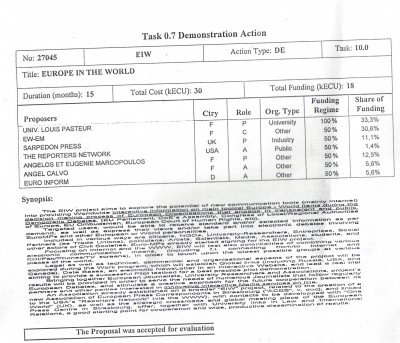
It's since 1997 that a group of EuroFora's founders have officially presented a pioneer Project (then called "EIW", for "Europe in the World"), which aimed to develop Strasbourg's "Polyphonic music", by providing "Interactive information", on "main issues ... during the Decision-making process of European Organizations which engage in Transparent and Public Democratic Debates"
This should be done, inter alia, by "exploring the potential of New Communication Tools (mainly Internet)", as well as classic-form debates, the 1997 EIW pioneer project's anounced in its "Synopsis". It was formally "accepted for evaluation" by EU Commission in Brussels in order to be examined for a grant in the framework of the "Research/Technology/Development (RTD) Programme in the field of Information Technologies", then called "ESPRIT", as a "Best Practice Pilot Project".
But the vital, urgent Political need for EU to search new, efficient ways to reach the People and interact with European Citizens, was really felt in Brussels and elsewhere only after the unprecedented in History 1999 and 2004 Majority Abstention in EU Elections, followed by 3 "NO" in Referenda in France, the Netherlands and Ireland, on 2005 and 2008...
In this New Political Landscape, we prepared a new, actualised and more developed version of our initial idea, in a simplified and more efficient form, thanks also to a large Experience accumulated during many years of EU/CoE/UNO Press work and Multi-lingual debates, with the New project "EuroFora" :
On 2006 we presented in Public its main lines during Questions/Replies that we raised at two Press Conferences by EU Commission President, Jose Baroso, and mainly EU Commission's vice-President, in charge of Communication policy, Margot Wallstrom, together with EU Parliament's vice-president, Alejo Vidal-Quadras, in Strasbourg, (Videos available), and we reminded it at various brief contacts with Commissioner Wallstrom in 2007 and 2008.
Meanwhile, a new Text was also presented for "EuroFora" Project mainly to certain Political and other personalities, at European, National or Regional/Local level, mainly in 2007, but also in 2008..
Now, after the unexpected 2008 Irish "NO", and before the 2009 EU Elections, which are due to be of exceptionally crucial importance for Europe's Future, the moment has obviously come to launch that project, progressively, but in real practice.
Whoever really cares for Europe and its Citizens is welcome to join, in one way or another. Only anti-European, anti-democratic, obscure or ignorant groups might oppose or attempt to "steal" and deviate the main idea.
But European Citizens, incited by enlightened political leaders, are those who will finally write the real History.