


 newsitems EUROCORPS Commander +EU JHA Head to EuroFora: Lisbon Treaty's Human Rights +Security/Defence horizon
EUROCORPS Commander +EU JHA Head to EuroFora: Lisbon Treaty's Human Rights +Security/Defence horizon


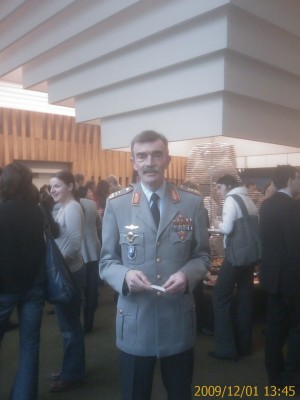
They both stressed in Strasbourg, headquarters of the European Court of Human Rights and of EUROCORPS, that, now, with Lisbon Treaty, new horizons on Human Rights and EU's Security and Defence have become possible and could evolve fast, mainly via the new method of "reinforced cooperations", but effective developments, and their timing, depend on political will....
In addition to EU's new Charter on Fundamental Freedoms, which entered into force today, Lisbon Treaty makes it possible and incites the EU to also become a member of the older and larger panEuropean Convention on Human Rights :
A "useful" move both in order to ensure a "coherence" on EU Citizens' rights' case-law between the EU Court of Justice at Luxembourg and the European Court of Human Rights in Strasbourg, and because "they don't cover exactly the same areas", Brun observed to "EuroFora".
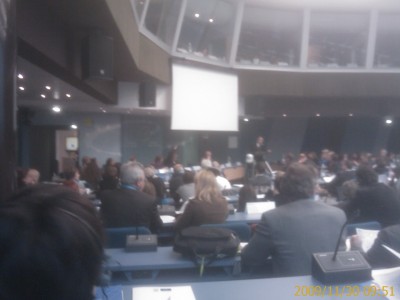
Significantly, he spoke on the sidelines of a joint EU - CoE Conference on Childrens' Rights, fex. vis a vis Adoptions, trafficking, etc, where participants (EU/CoE Officials, politicians, experts, NGOs, journalists, and even individuals whose life had been seriously affected by various related issues) held "hot" discussions highlighting various problems still in need of the right answers, well beyond an International Hague's Treaty and a specific CoE's Convention, which still left several unanswered questions open
For the Legal, technical matters, "we have been prepared since a long time ago, so that we can move quite fast" for EU's accession to the ECHR, the experienced EU's Head of JHA's services told us.
According to CoE's sources, this might, eventually, include, fex. also a guarantee that EU institution's acts would be monitored by a special EuroCourt's Chamber composed by EuroJudges coming only from EU Member States, and not from other, Third Countries, among PanEuropean CoE's 47 Member States.
- "But the ratification process might take longer than scheduled", Brun warned. Eventual delays might come "not so much from EU Member States, since they have all, already accepted Lisbon Treaty which provides for EU's accession to the ECHR, but from others" : The PanEuropean "CoE (under whose auspices works EuroCourt) has 47 Member States, i.e. 20 Countries more than the EU (fex., since the end of the "Cold War" and Germany's and Europe's ReUnification : Russia, Ukraine, and other former "Eastern European" Countries, but also Turkey, etc., since the particular era when the "Cold War" had started in the Past : 1950).
So, "we don't know, in advance, whether there might be any objection or delay from anyone among these 20 more Third Countries, which are now members of the CoE, but not of the EU", he observed.
That's one of the reasons for which "the ratification (of EU's entry into the ECHR, which will open the possibility for EU Citizens to challenge EU Institutions' acts if they affect their Human Rights) might take as long as about 3 or 5 Years more", the EU Top Official carefully estimated.
- "In fact, it all depends on Political factors", Alain Brun concluded, pointing at the incoming EU Commissioner on Justice and Home affairs, Mrs Viviane Reding from Luxembourg, who has been appointed in order to succeed to Jacques Barrot from France in the framework of the New EU Commission from January 2010.
------------------------------------------.
But developments might be faster on another, partly complementary, issue of particular importance to Strasbourg-headquartered European bodies : EU Defence and Security capabilities, mainly with EUROCORPS, the multi-modal and multi-national European Army's "Etat Major" :
- After Strasbourg Treaty entered into force, at the beginning of 2009, ratified by all 5 "Framework Nations" (France, Germany, Belgium, Luxembourg, Spain), to which are added other 5 "Sending" Nations represented by Liaison Officers, while EU Parliament was voting a landmark Resolution calling for the creation of a European Defence and Security policy based on the use of EUROCORPS' tool, it has a Legal frame and Democratic support for further developments of a European Defence, observed his New Chief :
- "What is needed now is that somewhere among the framework nations, emerges a "Driving Force" to boost the European Defence and Security policy", stressed from the outset EUROCORPS' new Commander for 2009-2010, Lieutenant General Hans-Lothar Domroese from Germany, speaking to "EuroFora".
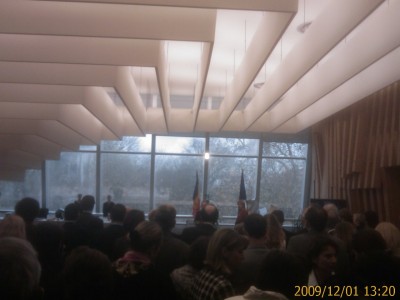
Perhaps significantly of EUROCORPS' Enlargement possibilities, his new Commander took over his duties by succeeding to a Spanish General, just before Spain chairs the EU in the 1st semester of 2010, and was present at a CoE event on the "double Anniversary of Romania's National Day and of EU Lisbon Treaty, on December 1st 2009", as CoE's Deputy Secretary General, Mrs Maud de Boer-Bucquichio observed
Domroese, speaking the day Lisbon Treaty entered into force, akcnowledged that the possibility it provides for "Reinforced Cooperations" speaheaded by initiatives undertaken by some pioneer EU Member States and open to all other willing EU Member Countries is an adequate and efficient tool in that direction.
- "But, in fact, it all depends on Political WIll", EUROCORPS' new Commander warned.
Domroese, who has already served even at Afghanistan for a few months at the beginning of 2009, aqreed however with "EuroFora" that, at least at the start, EU's Defence capabilities' development can become soon Popular among EU Citizens, fex. by protecting EU's external borders, intervening in Peace-keeping operations in preference around Europe's Neighbouring Countries, (fex. in Cyprus, if a Peace deal for its ReUnification is made with a European/International Guarantee), helping to face "Natural Desasters", etc
The new EUROCORPS' Commander, who took over his duties on September 2009 for 2 crucial years, speaking at the CoE to "EuroFora" appeared optimistic but also careful to further enhance both EUROCORPS' capabilities and political support in 2010.
ESDP was the only one among France's 2008 EU Presidency's priorities who did not had enough time to be fulfilled then, particularly after it had to struggle (successfully) both against the unforeseen Global Economic Crisis and to stop an unprecedented Russia - Georgia War.
Significantly, EU Parliament has recently decided to create, for the 1st time, a specific "Security and Defence Committee", which had been initially entrusted to the experienced German f. MEP Carl Von Wogau, from nearby Fribourg, (the "father" of EU's Monetary Union among MEPs, since he had worked for 10 Years as former President of EU Parliament's Economic Committee for the creation of EuroZone, before starting to help build EU's Defence). After June 2009 EU Elections, EU Parliament elected as new President of its Security and Defence Committee the mainstream new MEP Arnould Danjean, from the Governing French Party UMP, a specialist of ESDP and GeoPolitical issues with personal experience even on the spot (Balkans, etc), who is well known among French President Nicolas Sarkozy's close councilors, as well informed sources from the Presidential Elysee palace said to "EuroFora".
Main Menu
Haupt Press Deontology/Ethics 2009 Innovation Year EU endorses EuroFora's idea Multi-Lingual FORUM Subscribers/Donors Häufig gestellte Fragen Die Elxis Lizenz Erweiterte Suche EuroFora supports Seabird newsitems In Brief European Headquarters' MAPs CoE Journalists Protection Platform
BRIEF NEWS
- 00:00 - 02.06.2021
- 00:00 - 18.10.2020
- 00:00 - 19.06.2020
- 00:00 - 18.05.2020
- 00:00 - 20.04.2020
- 00:00 - 02.02.2020
- 00:00 - 09.12.2019
- 00:00 - 27.11.2019
- 00:00 - 16.11.2019
Popular
- Yes, we could have prevented Ferguson riots says World Democracy Forum's Young American NGO to ERFRA
- Spanish People Elect CenterRIGHT Majority with 1st Party and Total of 178 MPs (6 More than the Left)
- Pflimlin's vision
- The European Athletic "Dream Team", after Barcelona 2010 Sport Championship Results
- Source Conseil d'Europe à ERFRA: Debatre Liberté d'Opposants à Loi livrant Mariage+Enfants à Homos ?
- Head of BioEthics InterGroup, MEP Peter Liese : "Embryonic stem cell research reaching its END" !?
- Spain: Jailed Turkish Terror suspect with Explosive,Drones,Chechen accomplices stirs Merah+ Burgas ?
- UN Head Ban Ki Moon at CoE World Democracy Forum : - "Listen to the People !"
Latest News
- Test Photos (f.ex.+ Invit to EU + Korea Peace meeting)
- EUOmbudsmen Conference 2022: Digital Gaps affect People's Trust threaten EF Project on EU Future ?
- French Election : Black Out on Virus, but Obligation for Fake 'Vaccines" Challenged
- Both French Presidential Candidates point at "Humanism" in crucial times...
- France : Zemmour = Outsider may become Game Changer in Presidential + Parliamentary Elections 2022
Statistics
Besucher: 64267770Archive
Login Form
Syndicate


Other Menu
Ten Years of ECHR : 1998 - 2008 show need of Revival in 2009-2010 coinciding with 2009 EU Election
A threefold, coordinated move by new Top French Political actors in the 2009 EU Parliament Elections, expressed in Strasbourg a will to boost Europe's Political dimension close to Citizens' concerns, going from protection of Economy to defence of Human Rights.
The move met an exceptional ECHR's call for a "revival" of Human Rights' protection mechanism', in a Mega-Conference, early 2010.
Obviously focusing on June 2009 Elections to EU Parliament, it involved from the outset the recently nominated "dual" Head of French Governing Party (UMP) Michel BARNIER and Rachida DATI :
- "As President Sarkozy has clearly said, we (France) are in favor of a Strong, Sovereign and Independent, Political Europe, which protects its Citizens, and not for a large Super-Market, nor for a Europe under influence",
"This goes for everything, including Energy", added to "EuroFora" the experienced former EU Commissioner, Minister of Foreign affairs, currently of Agriculture and Sarkozy's new pick as Leader of the Governing party UMP to EU 2009 Election, Michel BARNIER .
- Human Rights are important because they are at the Heart of the Political Europe that we aspire for : I.e. a Europe able to act and protect its Citizens, stressed also the New French Minister for European affairs, Bruno LE MAIRE, while meeting Strasbourg's Journalists at his first visit to the CoE.
This is one of the main interests for CoE, which is also a natural place for cooperation between EU countries and Russia or Turkey, which was recently helpful at the Middle East crisis, he added.
The move gained momentum with French Minister of Justice, Rachida Dati's main observations at ECHR's 5Oth Anniversary :
- "While we are seeking Europe's Borders and Identity, you (ECHR) remind us also of its Values", Human Rights, Dati noted.
Citizens seek more and more often ECHR's help, and the tempo accelerates, Europa awaits a symbol, while national legal orders are not freezed
And she expressed "support" to ECHR President Jean-Paul Costa's call to satisfy the vital need to revigorate the PanEuropean Court by deciding big changes at a High-Level Conference open to a large audience, a kind of "Etats Generaux" of Human Rights, at the beginning of 2010.
It's not so much the recently growing number of applications for Russia or Ukraine etc, which seems to be Costa's main concern : In fact, the cases declared "admissible" are much fewer...
But rather the persistent violations of Human Rights, sometimes very grave (ie. murders, torture, abritrary deprivation of liberty, oppression of freedom of speech, destructions of homes/properties, etc), despite numerous, repeated condemnations by ECHR. So that CoE's Ministers, due to "supervise execution" of ECHR's judgements, are overloaded.
F.ex. most Media noted that Turkey still remains, even in 2008, the 1st among 47 CoE member States in the number of condemnations by ECHR : 257, compared to 233 for Russia, with a population more than the double..
The problem is that it's not the 1st time at all : During all the last Decade 1998-2008, Turkey was condemned by ECHR much more than any other State, and for particularly grave violations :
- 1.652 condemnations, compared to 605 for Russia, 548 for Poland, 494 for France, 476 for Ukraine, etc.
Italy's second place with 1.394 condemnations is a misleading false appearance : In fact, most of them (999) concern mere "procedural delays" in national courts. Same for France.
On the contrary, Turkey was condemned 180 times for Killings, 192 times for Torture or Inhuman/Degrading treatments, 340 times for arbitrary deprivation of Liberty, 528 times for "Unfair trial", and 169 times for oppression of Freedom of speech, (etc). And the latest, 2008 numbers, indicate no change in this trend, (See supra).
The current Spanish CoE Presidency (November 2008 - May 2009) has made of the implementation of ECHR's judgements its 1st Priority.
ECHR's President, Jean-Paul Costa, stressed in its 2009 Annual Press Conference, CoE Member States' obligation to implement the judgements, according to Article 46 of the European Convention on Human Rights.
Moreover, if CoE's Committee of Ministers delays to ensure implementation, then, the repetition of violations in similar cases provokes a multiplication of complaints tabled to the Court, which overload the mecanism for the protection of Human Rights, denounced Costa.
A series of Debates on "the situation of Human Rights in Europe", focusing on the "need to fight against Impunity" of perpetrators of grave crimes, is currently prepared by CoE's Parliamentary Assembly for the session of June 2009.
The final Timing comes shortly AFTER the EU Elections, but the main Reports should have been adopted before.
Meanwhile, French President Sarkozy and German Chancelor Merkel's recent call "for a Political Europe" in 2009 EU Elections (See earlier "correspondence from Paris, Elysee Palace), seems more and more endorsed also by other EU Countries' Top MEPs :
Thus, f.ex., EU Parliament's 1st vice-President, Greek MEP Mrs Rodi KRATSA, speaking to "EuroFora", agreed that 2009 EU Election would be a "naturally good" opportunity to debate what really interests EU Citizens : "The Future of a Political Europe, able to face the Economic Crisis, with a Culture and identity which attracts the People"
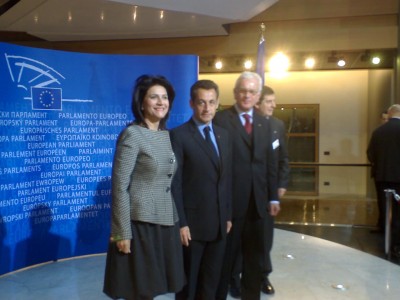
(Photo taken earlier during Sarkozy's 1st visit at EU Parliament, in 2007 : Sarkozy and Merkel's Ideas for a Political Europe inspire also other EU politicians accross the continent)...