


 newsitems ECHR President Raimondi to EF on Discretionary Power: Decision-Making proces(Dialogue State-Citizen?
ECHR President Raimondi to EF on Discretionary Power: Decision-Making proces(Dialogue State-Citizen?


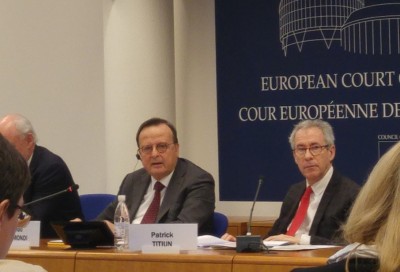
*Strasbourg/ECHR/Angelo Marcopolo/- Replying to an "Eurofora"s Question at the Annual Press Conference of ECHR, its experienced President, Guido Raimondi from Italy, explained that the PanEuropean Court of Strasbourg "is Developing" quite wide possibilities for Judicial Control of Public Authorities' Discretionary Power, in order to Prevent eventual Abuse vis a vis Citizens, inter alia, also by imposign the Respect of a Number of Rules, concerning the Decision-Making process of any Public Administration, (f.ex., Prior Information of affected Citizens, Contradictory Procedure, Sufficient and Correct Motivation of Decisions, etc), i.e. in a way quite similar to an elementary Dialogue between States and Citizens Before Taking Important Decisions which Affect their Lives and/or Society at large, as "Eurofora"s Wider Project and Views support since a long time.
Such ECHR's moves (that President Raimondi analyzed here in a Crystal-clear way) coincide also with Both relevant EU Developments, particularly since Lisbon Treaty, as well as with even more Recent COE's PanEuropean Legal Space's own developments, as "Eurofora" has already Highlighted recently, (See, f.ex.: http://www.eurofora.net/newsflashes/news/coeruleoflawchecklistandeuroforaproject.html, etc).
-----------------------------------------
- In our Question, "Eurofora" started by pointing at the Fact that : -"A Few Months ago, in Strasbourg, CoE's Parliamentary Assembly endorsed a Measure adopted by the Venice Commission, (supported also by the Congress of Local/Regional Authorities of Europe : CLRAE), which concerns a General Mechanism, for All (COE's 47) Member Countries, about the relations between Citizens and Public Authorities, in order to Prevent Risks of Abuse of Discretionary Power."
- "I.e. when a State can Decide Whatever they like, in the Substance of the matter, But has to Respect a Series of (Decision-Making Process') Rules, that we know also in Adminstrative Law : As, f.ex., to Inform the Persons involved, to Hear them Before it Decides, to present a Motivation that is Sufficient, (Legally and Factaully) Correct, etc", we explained in this regard.
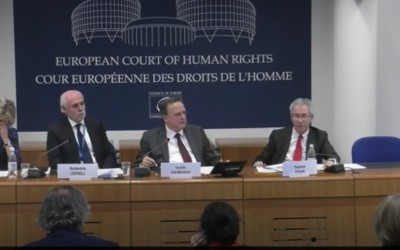
- "Obviously, it's Not Directly and Explicitly Linked with some ECHR Articles. But, according to your Experience, is there Something - or there Might be Something, Hopefully - inside the PanEuropean Mechanism for Human Rights, - as there are some Similar things in EU Law, after Lisbon Treaty (EIF : 2010) - which Could Develop, in the foreseable Future, a kind of Guarantee against Abuse of Discretionary Power ?", "Eurofora" asked ECHR President Raimondi.
----------------------------------
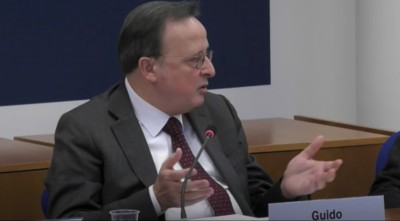
- ECHR's President reacted Positively, as he said, - "On your Interesting Question, concerning (Public Authorities') Discretionary Power, and possible Control by our (PanEuropean) Court :"
- "This is an Interesting Question, especialy Because the Range of (Public) Administrative activities, and the Role of the State in the Social Life, Developed and Increased, across the board, in CoE's 47 Member States, in Recent Years", Raimondi observed from the outset.
- "But we (ECHR) have Developed a quite Rich Jurisprudence on that Issue : "
- Even if, as "You Know, UnLike of Article 47 of (EU's) Charter of Fundamental Rights, which Covers All sorts of Jurisdiction (i.e. also Administrators, and Not only Judges), Our (CoE's) corresponding Provision in the (PanEuropean) Convention (on Human Rights), i.e. Article 6, (which is) Providing Guarantees of "Fair Trial", does Not Apply to All Forms of Jurisdictional Proceedings".
- "So, in order to Trigger the Protection of Article 6, you Need Either a writer Obligation of a Civil Rights, or an Accusation in Criminal matters. Of course, these 2 Noions are developed Autonomously by the Case-Law of ECHR", (which, therefore, can have a Wider Scope of Action, if it wishes so : See Infra).
=> "In this connection, the activity of the Public Administration may Fall Within he Scope of Application of Article 6 : Either Because a Civil Right is at Stake , either because what is considered as an Administrative Action in the National Law, is considered, in the Autonomous Evaluation of ECHR, (Comp. Supra), as a <<Criminal Sanction>>, which Triggers the Protection of Article 6".
- "Of course, it's a Delicate Question, Because we are confronted with the Theory of Separation of Powers. So, we (ECHR) Require that, when Article 6 Applies, the Judge has to have what we call "Full Jurisdiction". But this has to be understood with Caution, when it comes to the Control of Activities of the Public Administration", he warned. "Because of the (Constitutional) Principle of Separation of Powers".
- "We (ECHR) have developed a Rich Jurisprudence on this : I'd say, the Most Important Case in this direction is "Sigma TV against Cyprus", that you may know", President Raimondi indicated.
- "And there are a Number of Principles, which have been developed, in this connection : One of them, is, for instance, that, if the Judicial Body, which is called upon to Review judicially the Behavior of the Public Administration, has Not the Power to Assess the Facts, and canNot Rely on an Independent Assessment of the Facts, that is, for instance, a Problem, in the context of Article 6 !", he pointed out. "And this is one the Examples".
- "So, the (ECHR's relevant) Jurisprudence is, Already, Rich, and it is Developing".
- F.ex., "there is a Case which is Pending : Ramos Nunes v. Portugal", which will be Delivered in the Forhcoming Months, by the Court, and may provide some Further Clarification on that Issue", he Announced in fine.
+ As for a Comparison with the relevant EU Law, the presence of ECJ's President, Tomorrow in Strasbourg, at the Official Opening of the New Judicial Year of 2018, (on the occasion of which, is organized a Timely Seminaire focused on "the Authority of Judicial Power" : Comp. Supra), might be very Interesting, potentially, in this regard too. ECHR and ECJ have indeed, Recently developed a very close Cooperation, President Raimondi stressed earlier Today.
-----------------------------------
Main Menu
Home Press Deontology/Ethics 2009 Innovation Year EU endorses EuroFora's idea Multi-Lingual FORUM Subscribers/Donors FAQs Advanced search EuroFora supports Seabird newsitems In Brief European Headquarters' MAPs CoE Journalists Protection Platform
BRIEF NEWS
- 00:00 - 02.06.2021
- 00:00 - 18.10.2020
- 00:00 - 19.06.2020
- 00:00 - 18.05.2020
- 00:00 - 20.04.2020
- 00:00 - 02.02.2020
- 00:00 - 09.12.2019
- 00:00 - 27.11.2019
- 00:00 - 16.11.2019
Popular
- Yes, we could have prevented Ferguson riots says World Democracy Forum's Young American NGO to ERFRA
- Spanish People Elect CenterRIGHT Majority with 1st Party and Total of 178 MPs (6 More than the Left)
- Pflimlin's vision
- The European Athletic "Dream Team", after Barcelona 2010 Sport Championship Results
- Source Conseil d'Europe à ERFRA: Debatre Liberté d'Opposants à Loi livrant Mariage+Enfants à Homos ?
- Head of BioEthics InterGroup, MEP Peter Liese : "Embryonic stem cell research reaching its END" !?
- Spain: Jailed Turkish Terror suspect with Explosive,Drones,Chechen accomplices stirs Merah+ Burgas ?
- UN Head Ban Ki Moon at CoE World Democracy Forum : - "Listen to the People !"
Latest News
- Test Photos (f.ex.+ Invit to EU + Korea Peace meeting)
- EUOmbudsmen Conference 2022: Digital Gaps affect People's Trust threaten EF Project on EU Future ?
- French Election : Black Out on Virus, but Obligation for Fake 'Vaccines" Challenged
- Both French Presidential Candidates point at "Humanism" in crucial times...
- France : Zemmour = Outsider may become Game Changer in Presidential + Parliamentary Elections 2022
Statistics
Visitors: 67318428Archive
Login Form
Syndicate


Other Menu
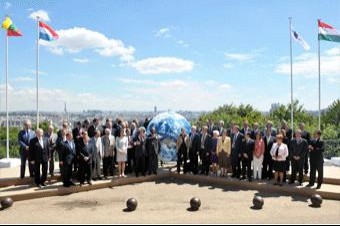
It's at a splendid Natural landscape, inside a Forest plateau with superbe view over Paris, at Saint Cloud, that the incoming French EU Presidency had the good idea to join together all EU Member Countries' Ministers of Environment and Energy, in two overlaping EU Councils in a series, from 3 to 5 July 2008.
Fresh rain happily dissipated July's heatwave, before a bright Sun shined at the conclusion of the EU gathering around a huge statue of Earth (See Photo).
French super-Minister of State for Energy, Transport and Environment, Jean-Louis Borloo, and Minister for Environment, Nathalie Kosciusko-Morizet chaired the first EU Ministerial meeting at Paris' area, together with EU Commissioners Demas and Pielbags, surprising Journalists with improvised Press-points, at key-moments of the discussions.
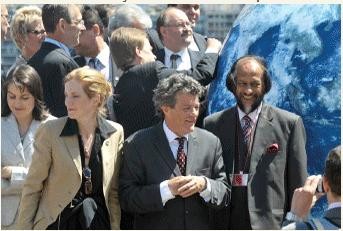
Environment and Energy are key to the development of New Technologies to boost Europe's role in the World, while also responding to Citizens' concerns, stressed Borloo, speaking to Journalists earlier in Strasbourg.
According to well-infomed sources from the French EU Presidency, the aim is to stimulate a growing trend inside EU Parliament, via various on-going Reports developping in parallel, towards achieving the necessary targets before December.
For this purpose, Top-level representatives from Borloo's super-Ministry are expected to come in Strasbourg during EU Parliament's plenary, next Wednesday, a key official told "EuroFora".